
The best flowers around a mailbox in full sun are tough, long-blooming plants that handle reflected road heat and dry soil: perennial salvia, catmint, coreopsis, blanket flower and sedum, with zinnias and moss rose for summer color. Full sun means six or more hours of direct sun a day, and a mailbox at the curb often gets more. Keep taller plants behind or beside the post, keep the road-facing edge low, and leave the door, flag and house number clear at the plants’ mature size.
Best Flowers Around a Mailbox for Full Sun and Road Heat
Last updated:
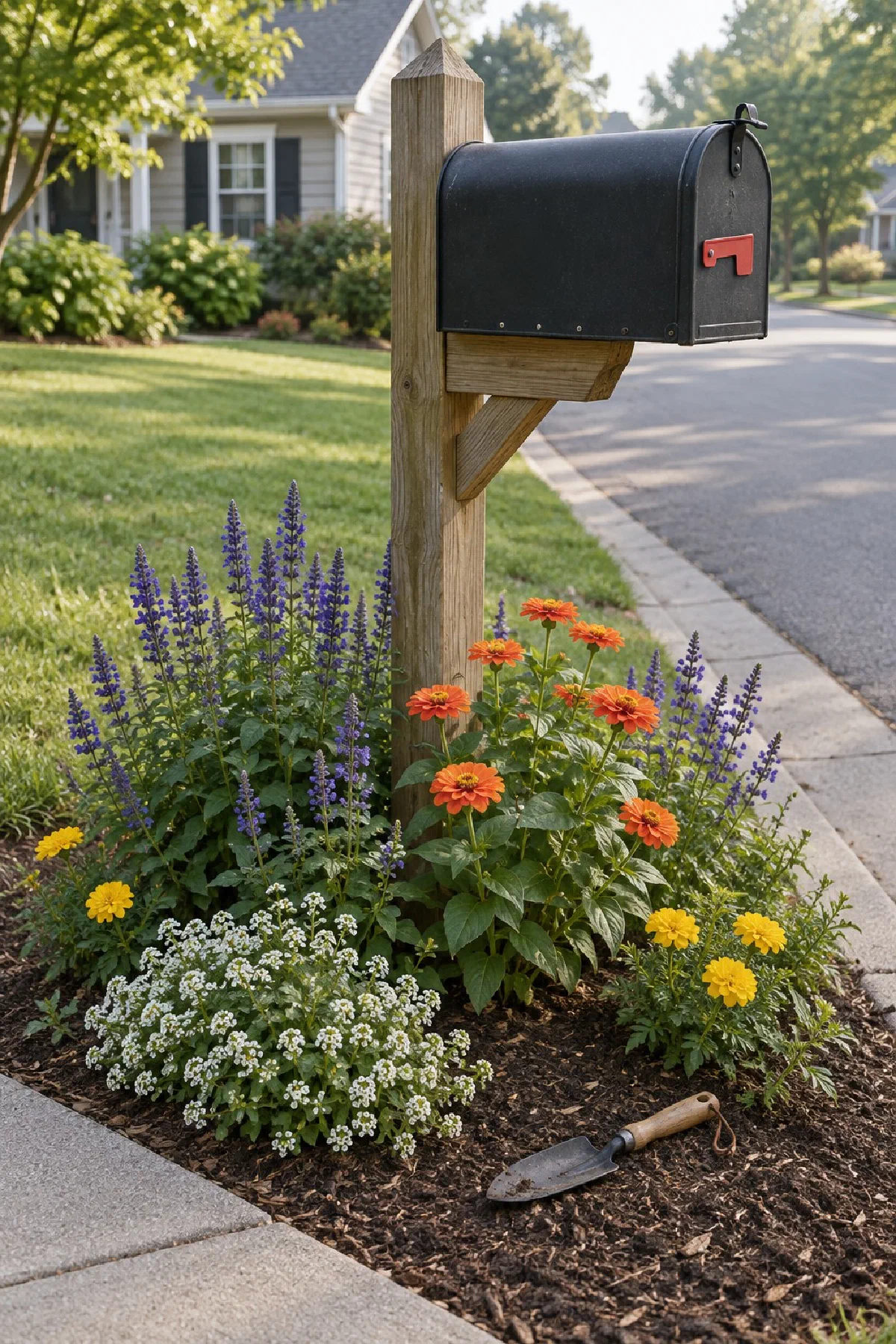
Illustrative scene, not a photograph of the linked products.
Road salt and reflected heat are separate problems. A plant that shrugs off a dry summer is not automatically safe from winter salt, so each gets its own check below.
Check the spot before choosing flowers
Penn State Extension’s roadside planting guide describes full sun as six or more hours of direct sun, part sun as four to six hours, and part shade as two to four. Watch the mailbox area through the day instead of assuming an open roadside gets the same light as the rest of the yard.
Check whether pavement reflects heat, rain collects around the post, or salted runoff enters the bed. Note how far you must carry water. A drought-tolerant perennial still needs a drink while its roots establish.
Check local roadside planting and utility rules before digging, and keep the delivery approach usable.
Compare sixteen plants by mature size
The ranges below are planning values. Cultivars differ, so use the nursery label for the plant you are actually buying. An annual plant does not become frost-hardy because it is grown in a particular USDA zone.
| Plant | Mature height | Spread | Bloom window | USDA zones |
|---|---|---|---|---|
| Lantana (Lantana camara) | 1 to 3 ft grown as an annual | 2 to 3 ft | Late spring to frost | 9 to 11, annual elsewhere |
| Zinnia (Zinnia elegans) | 1 to 3 ft | 12 to 18 in | Early summer to frost | Annual in all zones |
| Perennial salvia (Salvia nemorosa) | 18 to 24 in | 18 to 24 in | Late spring, reblooms if cut back | 4 to 8 |
| Catmint (Nepeta x faassenii) | 18 to 24 in | 24 to 36 in | Spring into summer, repeats if sheared | 5 to 9 |
| French marigold (Tagetes patula) | 6 to 12 in | 6 to 12 in | Late spring to frost | Annual in all zones |
| Purple coneflower (Echinacea purpurea) | 2 to 4 ft | 18 to 24 in | Midsummer to early fall | 3 to 8 |
| Black-eyed Susan (Rudbeckia fulgida) | 2 to 3 ft | 18 to 30 in | Midsummer to early fall | 3 to 9 |
| Threadleaf coreopsis (Coreopsis verticillata) | 12 to 24 in | 18 to 24 in | Early summer to early fall | 3 to 9 |
| Blanket flower (Gaillardia x grandiflora) | 12 to 24 in | 12 to 24 in | Early summer to frost | 3 to 9 |
| Autumn sedum (Hylotelephium telephium) | 18 to 24 in | 18 to 24 in | Late summer into fall | 3 to 9 |
| Verbena (Verbena x hybrida) | 6 to 12 in, trailing | 12 to 36 in | Spring to frost | 9 to 11, annual elsewhere |
| Daylily (Hemerocallis) | 12 to 36 in | 18 to 36 in | Early to midsummer, longer on rebloomers | 3 to 9 |
| English lavender (Lavandula angustifolia) | 18 to 24 in | 24 to 36 in | Early to midsummer | 5 to 8 |
| Moss rose (Portulaca grandiflora) | 4 to 8 in | 12 to 18 in | Summer to frost | Annual in all zones |
| Creeping thyme (Thymus serpyllum) | 2 to 4 in | 12 to 18 in | Late spring to early summer | 4 to 9 |
| Sweet alyssum (Lobularia maritima) | 4 to 8 in | 6 to 12 in | Spring to frost, pauses in peak heat | Annual in most zones |
Catmint’s numbers come from the NC State Extension Plant Toolbox, which lists blue catmint as drought tolerant once established, happy in full sun to part shade, and sterile, so it is unlikely to seed itself around. Shear it after the first flush to encourage a repeat bloom.
Black-eyed Susan also comes as Rudbeckia hirta, the common wildflower form; check the tag, because the two differ in height and habit.
Choose lavender only where drainage suits it. Alyssum can pause in peak heat, so do not count on it to carry the hottest pavement edge all summer. Plant spread matters as much as height: a compact nursery pot may eventually fill a large part of a small bed.
Pick by zone
Use the zone column above to narrow the list for your winters.
| Your winters | Reliable picks from the table |
|---|---|
| Cold, zones 3 to 4 | Purple coneflower, black-eyed Susan, threadleaf coreopsis, blanket flower, autumn sedum, daylily. Salvia and creeping thyme from zone 4 |
| Middle, zones 5 to 7 | Everything above, plus catmint, and lavender where the drainage is sharp |
| Hot, zones 8 to 9 | Black-eyed Susan, coreopsis, blanket flower, sedum, daylily and catmint, plus zinnias, marigolds and moss rose each summer. Lantana and verbena stay perennial from zone 9 |
Flowers that bring bees and butterflies
Mailboxes sit in full sun, which suits the nectar plants. Martha Stewart’s mailbox garden ideas point to coneflowers, salvias and black-eyed Susans for bees and butterflies. Lantana is another butterfly plant, and the Fairview Garden Center notes that dipladenia blooms attract hummingbirds and bees. A pollinator-friendly mailbox bed only needs three or four of these repeated, not all of them.
Mailbox bed layouts and sizes
Pick a shape first, then fill it from the table. These are the layouts that keep coming up in mailbox garden guides, with the sizes they give.
| Layout | Size to plan for | Plants that suit it | Watch for |
|---|---|---|---|
| Round bed with a stone edge | A 3-foot circle fits compact plants (Holland Bulb Farms plans its mailbox garden on a 3-foot circle). Omni Home Ideas suggests 4 to 6 feet across so full-size plants are not crammed against the post, with 12 to 18 inch fieldstone for the edge | Salvia, coreopsis, catmint | Mature spread. A 3-foot bed cannot hold every plant at full size |
| Gravel or river-rock bed | 1 to 2 inch river stone over a smaller gravel base for drainage and weed control | Sedum, creeping thyme, moss rose | Leaves collect in the stone, and weeds still sneak through if the base is skipped |
| Ornamental grass bed | One cutback a year | Little bluestem, fountain grass or dwarf muhly grass with blanket flower | A bed of grass alone can look plain, so tuck in flowers |
| Cottage border | A strip with tall plants at the back and a low plant at the road edge | Coneflower, black-eyed Susan, daylily, alyssum | Keep the road side low so drivers and the carrier can see |
| Planter ring for tight spots | A ring 30 to 48 inches wide holds seasonal color, trailing plants or one compact shrub | Zinnia, verbena, moss rose | Pots dry out faster than ground, so plan to water |
Ornamental grass is the lowest-effort ornamental plant in this list; Omni Home Ideas calls it one of the smartest low-maintenance moves for a mailbox bed.
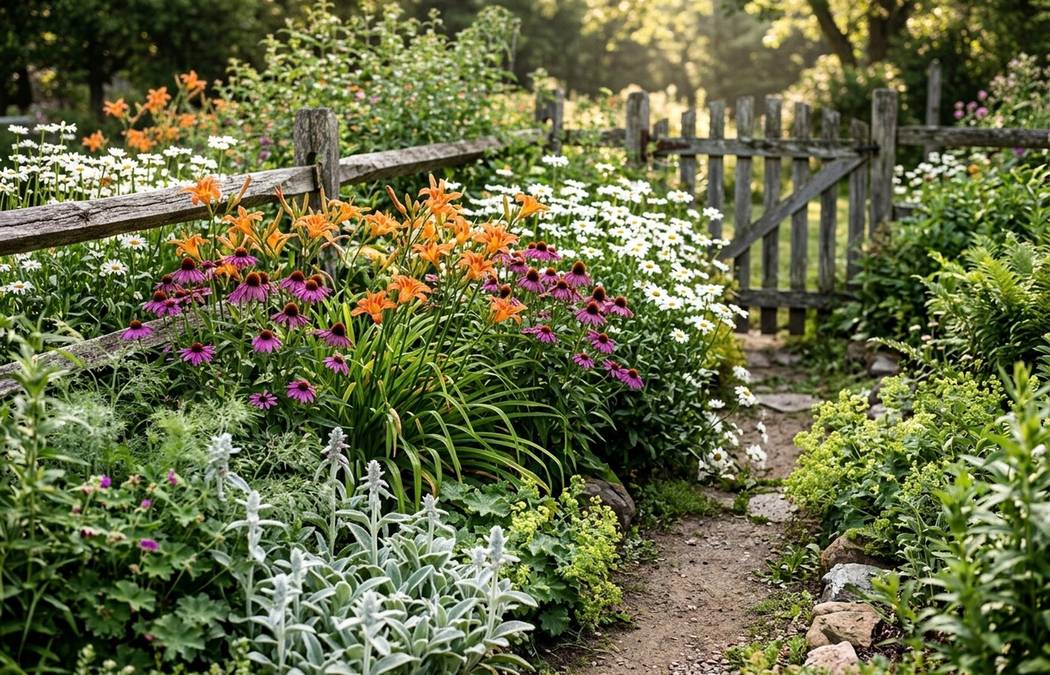
Mark the shape on the ground with a hose or rope and look at it from the street before you cut any sod. Leave about 6 inches clear around the house numbers and the mailbox door, as Omni Home Ideas advises.
What to put around the base of a mailbox
Start with the ground, then add the plants. A mailbox base wants something low, tidy and easy to trim around.
- Mulch: Omni Home Ideas suggests 2 to 3 inches deep, pulled back a few inches from the post and from plant stems.
- Gravel with low ground covers: landscape designer Nahal Sohbati, quoted by Martha Stewart, pairs gravel with low-growing ground covers for a neat base under taller grasses or perennials. Creeping thyme and moss rose from the table do this job.
- A short flowering plant: French marigold, sweet alyssum or moss rose along the edge, nothing taller than the bottom of the mailbox door.
Skip anything thorny or sharp. Gardentabs points out that thorns and spikes can injure the carrier.
Climbing a vine up the mailbox post
A post gives a vine something to climb, and it adds height without taking up bed space. Costa Farms suggests planting a mandevilla at the base, or clematis as an easy-care perennial vine with blooms from big pinwheels to small star shapes.
Clematis needs a few things from the spot, according to NC State Extension. It likes full sun but appreciates afternoon shade in hot summers, so shade the roots with mulch or a low ground cover. It wants moist, well-drained soil and a deep drink. A smooth mailbox post gives it nothing to grip, so wrap the post with wire garden fencing or netting, or tie the stems on with garden twine. Clematis sap can irritate skin, so wear gloves when you prune.
Annual vines are the simpler choice on a hot road. Fairview Garden Center calls black-eyed Susan vine (Thunbergia) a rapid grower that handles all-day sun and road heat and does not return, so it never seeds around. Mandevilla and the more mounding dipladenia want full sun and bloom hardest in summer heat.
Whichever you choose, prune the vine back from the mailbox door, the flag and the house number, and do not let it cover the box. Gardentabs makes the same point about the carrier’s access.
Build a small bed in layers
| Part of the bed | A starting choice | What to allow for |
|---|---|---|
| Behind or beside the post | Compact perennial salvia or catmint | Mature spread and room to reach the mailbox |
| Open side | Zinnias or French marigolds | Cultivar height, annual replacement and access for watering |
| Low edge | Moss rose in a dry sunny spot, or alyssum where summer heat allows it | Growth must stay clear of the pavement and delivery route |
| Perennial alternative | Coreopsis and an appropriate sedum cultivar | Drainage, mature spacing and winter appearance |
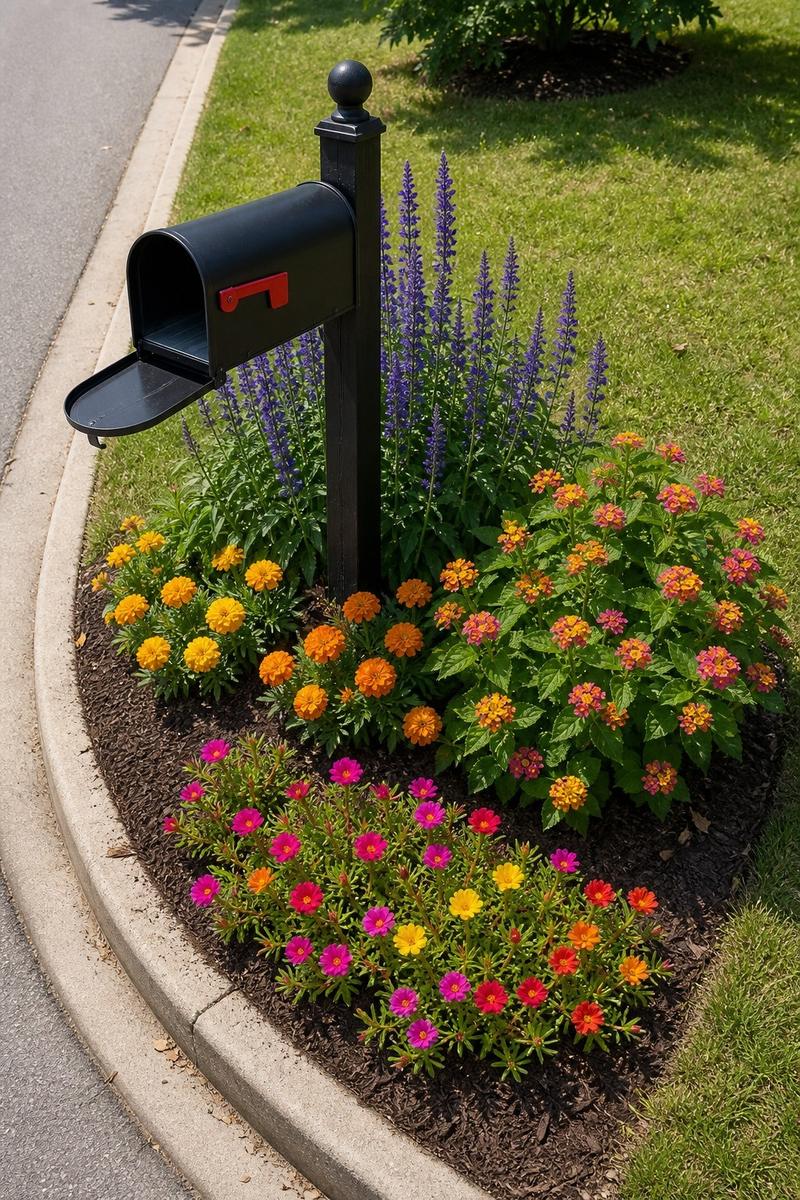
Repeat one flowering plant on each side rather than filling every gap with a different variety. Mark the eventual spread on the ground before digging.
Mailbox flowers are seen from the road, so tiny color details disappear. Choose two main colors, such as yellow with purple or pink with white, and plant them in blocks. A few yellow coreopsis, a row of red zinnias or purple salvia against white will read from the street better than a dozen small mixed blooms.
For a perennial bed, start with fewer plants at their recommended mature spacing. Add annuals only where there is actual room, and reduce them as the perennials grow.
Add a clean edge
A clear edge separates the planting from the lawn. Without one, grass creeps in and the bed starts to look accidental.
| Edge | What it looks like | Upkeep | Best for |
|---|---|---|---|
| Trench edge | A clean cut line between the bed and the lawn | Recut it once or twice a season | The smallest budget, and the fastest start |
| Metal edging | A thin, low line that almost disappears | Check for lifting or gaps each season | A curved shape, because it bends to the line you cut |
| Brick or stone | A visible border | Weeding between the pieces, and resetting any that heave | A house that already has brick or stone on it |
| Mulch ring only | No hard line, just a tidy circle of mulch | Remulching each year, and grass creeping back in | A rental, or a bed you might move |
Choose one edge material and keep the grass from growing through it.
Plant a mailbox bed in one afternoon
If the soil is workable, a small bed takes an afternoon.
- Water the ground the night before, or pick a damp day. Damp soil is easier to work than hard, dry ground; wait if it is waterlogged.
- Mark the shape with a hose, a rope or a ring of flour, then walk out to the street and look at it.
- Cut the edge first. Follow the line with a spade, straight down, and lift the turf inside it.
- Loosen the soil and work in compost if it is poor or compacted. Check for compaction beside pavement rather than assuming the whole bed needs it.
- Set the plants out in their pots first, move them until the spacing looks right from the street, then plant each at the depth it grew in the pot.
- Firm the soil and mulch a couple of inches deep, pulled back off the stems so nothing sits wet against the plant.
- Water slowly so the soil settles around the roots, and check moisture while the new plants establish.
- Stand at the street and check the front. If anything leans into the walking path or hides the box, move it now.
Keep a working space beside the post
The mailbox is a delivery point first. Leave room to open it, raise the flag and read the address without reaching through stems. Keep thorny plants and vigorous vines away from that approach.
Look at the planting from the road as well as from the house. Check sight lines and where a mower, trimmer or snowplow operates. Review the mature layout each season; a bed that was clear when planted can become obstructed later.
The next smallest planting job is a window box, and cottage-garden edges can help define a planted patch without expanding it.
Prepare for the soil you have
Inspect compaction and drainage before adding amendments. Use a soil test and local extension advice when the bed has persistent problems. More compost, fertilizer or water is not automatically the answer for a wet pocket or salt injury.
Use mulch appropriate to the plants and site, keeping it away from stems and crowns. Leave the border accessible for weeding. A small repeated planting is easier to maintain than a crowded ring of many varieties.
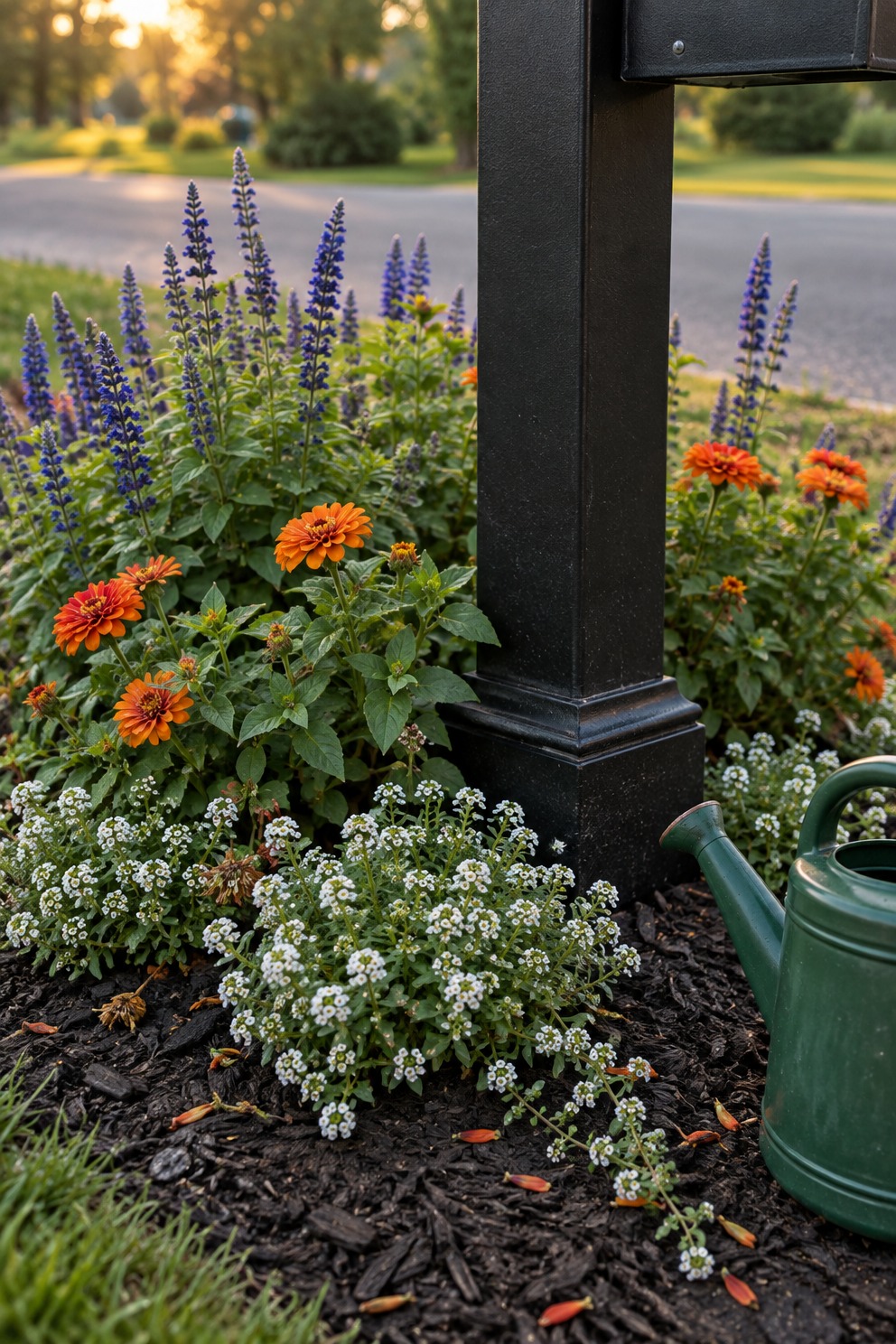
Treat winter road salt as its own problem
Penn State’s salt-tolerant planting guidance is a starting reference, but check the exact species and cultivar for your region. Plants that tolerate dry summer soil may still be damaged by deicer spray or runoff.
Look at where meltwater enters the bed. If damage is concentrated along the road, seek local advice before fertilizing or trying to flush the soil. Flushing is unsuitable where the water cannot drain, and a fixed amount of irrigation is not a solution for every site.
Where exposure is severe, a smaller planting farther from the runoff may be more practical than replacing the same flowers each year. Containers also need a safe location and winter care; they do not remove every roadside problem.
If the mailbox is in part shade
Penn State counts two to four hours of sun as part shade. In that light, compare coleus, begonias and heuchera, with ajuga near the edge, instead of the sun list above. Check each variety’s mature size and light needs before you buy, and expect fewer blooms than a full-sun bed would give.
Three container supplies to compare
Use containers only where they leave the approach clear and can be maintained safely. These are alternatives for a specific container job, not required extras for an in-ground bed.
| Product | When to consider it | Check first |
|---|---|---|
| SnugNiture 22-inch round planters, black pair (opens Amazon in a new tab)As an Amazon Associate, we earn from qualifying purchases. Full disclosure. | A taller decorative container fits beside the planting | Interior volume, drainage, filled stability and room for mature plants |
| Worth 9-gallon tall round planters, beige pair (opens Amazon in a new tab)As an Amazon Associate, we earn from qualifying purchases. Full disclosure. | A larger container is needed for the selected plants | The listing gives 14-inch diameter and 21-inch height. Confirm drainage and filled weight |
| Miracle-Gro Moisture Control potting mix, 8-quart two-pack (opens Amazon in a new tab)As an Amazon Associate, we earn from qualifying purchases. Full disclosure. | A container needs a potting mix suited to its plants | Follow the label and plant requirements. It does not replace watering, and it is not a universal amendment for an in-ground bed |
All three were in stock on Amazon on October 11, 2026. The planter options have different sizes; choose by the planting and site rather than a price tier. Do not assume an empty lightweight planter will withstand roadside wind.
Questions to settle before planting
What is the best low-maintenance plant to put around a mailbox?
Catmint is a strong first pick: NC State Extension lists it as low maintenance and drought tolerant once established. Perennial salvia, threadleaf coreopsis and autumn sedum from the table are the other tough perennials. Plant one or two of them, not all four.
What flowers can handle full sun and road heat?
Zinnias, lantana, moss rose, blanket flower and coreopsis from the table are the usual heat takers. Fairview Garden Center also names lantana, pentas, verbena and zinnias as mounding annuals that survive a missed watering or two.
Which perennials should I avoid near a mailbox?
Anything that spreads fast, anything thorny, and anything that will grow taller than the mailbox door. Mint is the textbook spreader: NC State Extension says spearmint spreads rampantly and is best grown in a container. Omni Home Ideas also suggests shrubs with a mature width under 4 feet for a mailbox bed.
Are annuals or perennials better here?
Annuals can provide seasonal color where you can water and replace them. A perennial base can reduce replanting, but it still needs establishment care, suitable spacing and a plan for winter. Use the site and your available time to choose.
Can hydrangeas or hostas work beside a mailbox?
Check the exact plant’s light, moisture and mature size. They are poor default choices for a hot, dry full-sun edge, but a different site can change that decision. Do not choose solely from a shaded porch photograph.
What makes the bed low maintenance?
A manageable size, a short plant list suited to the site, access to water and room to weed. Check for obstruction as stems grow. If the bed repeatedly needs rescue, reconsider the plant or location instead of adding more varieties.
What to read next
- Drought tolerant flowers that still bring color for the watering problem, since a mailbox bed is usually the last thing to get the hose.
- Full sun perennials that bloom without asking much if you want the structure planted once instead of buying annuals every spring.
- Front yard cottage garden edges that still look tidy for ways to separate the planting from the lawn.
- Window box flowers for a house that needs more color for the next-smallest planting job once the mailbox is done.
- Front yard landscaping ideas shows how to make the whole house look cared for.