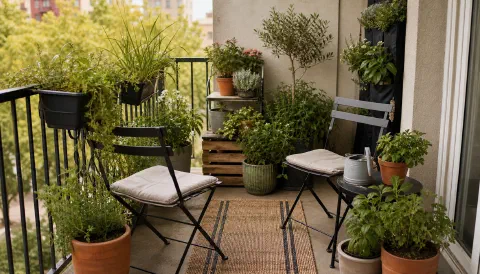
If your seats sit against the house, the easy answer is a pair of wired speakers screwed to the wall or tucked under the eave. If you want music out in the yard, or you would rather not see the speakers at all, landscape speakers (the rock, in-ground and bollard kind) spread the sound better. And if you rent, or just cannot run wire, a battery speaker you carry in at night will do the job.
Best Outdoor Landscape and Wired Patio Speakers
Last updated:
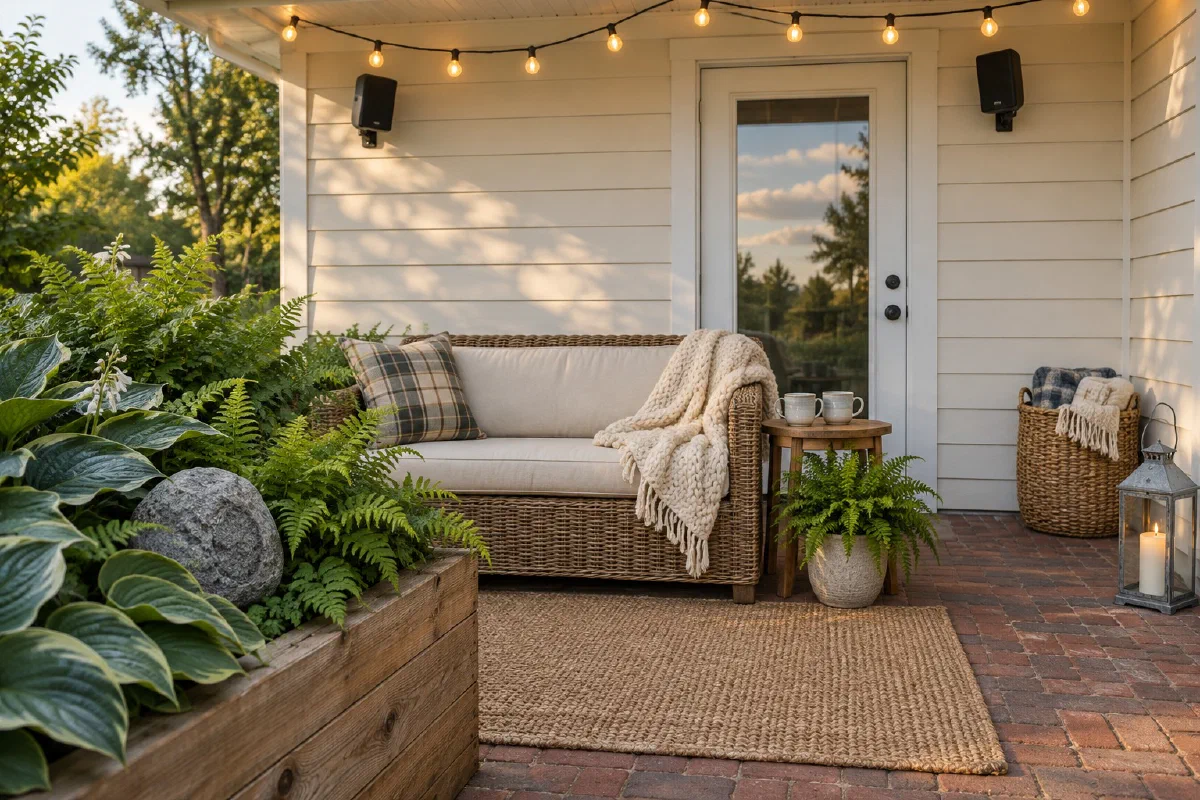
Styling idea, not a photograph of the linked products.
- Seats against the house or under a roof: a wired wall or eave pair.
- Seats out in the yard, or you want the speakers hidden: landscape speakers, rock or in-ground, with a buried subwoofer if you want bass.
- Rental, no drilling: a battery Bluetooth speaker you carry in.
- Already own a Sonos or Wi-Fi system: weatherproof speakers added to it with a matching amplifier.
Best outdoor speakers at a glance
Specs come from the What Hi-Fi? spec boxes (updated March 27, 2026) and the Tom’s Guide spec boxes, read October 20, 2026. A wired speaker’s watts are what it can take from your amplifier. A battery speaker’s watts are its own built-in output.
| Type | Model | Power | Weather rating | Battery | Best for |
|---|---|---|---|---|---|
| Wired, passive | Polk Atrium 4 | 80 W | IP66 | None | A covered patio against the house |
| Wired, passive | Klipsch AW-650 | 85 W | Durable, not IP rated | None | Installed bass on a larger area |
| Battery Bluetooth | JBL Charge 6 | 40 W | IP68 | 20 hours | Best all-around portable |
| Battery Bluetooth | JBL Xtreme 4 | 30 W | IP67 | 24 hours | A larger portable for yard parties |
| Battery Bluetooth | Bose SoundLink Max | 50 W | IP67 | Up to 20 hours | Premium sound, bigger box |
| Battery Bluetooth | JBL Go 4 | 4.2 W | IP67 | 7 hours | Budget, small, a table or a chair arm |
| Battery Bluetooth | Sony ULT Field 5 | 300 W | IPX4 | 20 hours | Bass at a party, but only splash resistant |
Wired, wireless and landscape speakers: what each one needs
A wired outdoor speaker has no power of its own. Speaker wire carries the music from an amplifier or receiver indoors. “Wireless” usually means a battery speaker you carry, or a Bluetooth speaker with an amplifier built in that still needs an outlet (Crutchfield names the OSD BTP-650 as an example). Landscape speakers are wired speakers in a different shell: a rock, a post or a stake.
| Type | Hook-up | Where it shines | The catch |
|---|---|---|---|
| Wall or eave pair | Wire to an amp indoors | The seats right in front of the wall | Sound stays near the house, so an open patio may need more than one pair |
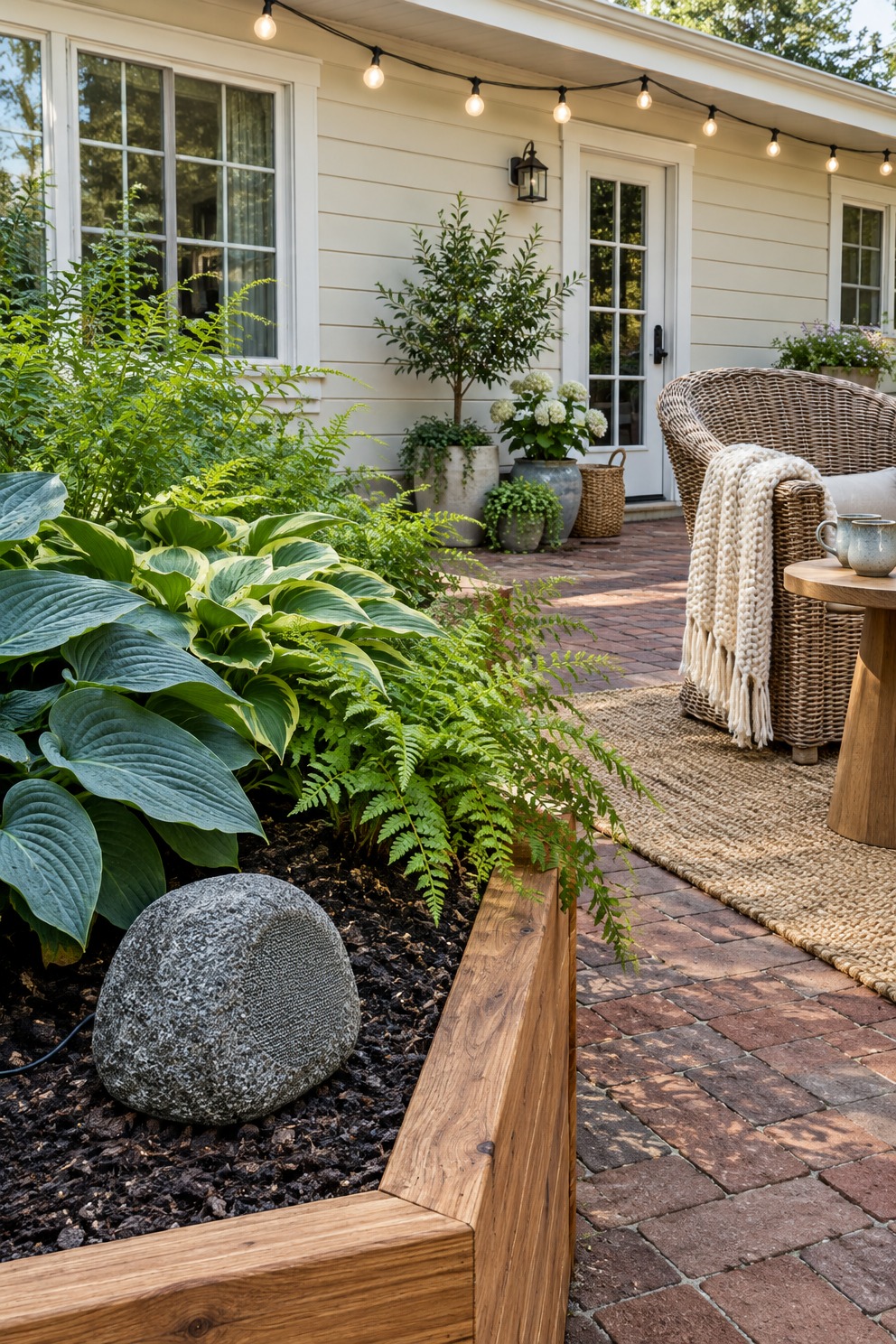
| Rock speaker | Buried wire to an amp indoors | Garden beds and yard edges, facing back toward the seats | Big for a speaker (the pick below is about 13 by 12 by 12 in), and it looks like a rock |
| In-ground or bollard | Buried wire to an amp indoors | Even sound across a seating area | Little bass on its own, so a buried subwoofer fills in |
| Battery Bluetooth | A charger | One spot, wherever you set it | Comes inside to charge, and it is only as loud as one small box |
What is the difference between landscape speakers and regular outdoor speakers?
A regular outdoor speaker hangs on a wall or eave and throws sound from one spot. That works near the house but gets thin further out, and Crutchfield’s point is that the further you sit from that spot, the less detailed the music gets. A landscape speaker sits low in the garden, so several of them can cover the whole seating area at about the same volume.
What reviewers pick for an outdoor speaker, and what they leave out
Most “best outdoor speaker” lists lean on the same few wired models. Tom’s Guide picks the Polk Atrium 4 for installations and the Klipsch AW-650 for installed bass, and notes the Klipsch is big enough to be a poor fit for a small area. Theater Calc leads with the Polk Atrium 6 and the AW-650, and says one pair covers a typical patio or a small-to-medium yard. Real Buyer Experiences prefers the AW-650 for clarity, and says rock speakers trade some clarity for being hidden.
Those lists agree on the speakers. They say less about how the yard feels: where the speakers sit, how many you need and what you see from your chair. That is what the sections below cover. If you want sound that carries, look at how loud a speaker plays for its size before the brand name, because an open patio has no walls to bounce sound back. The same open patio needs light after dark, so see small patio lighting ideas for a tiny backyard.
How many watts does an outdoor speaker need?
Plan on at least 40 watts per channel from the amplifier, says This Old House. SoundCertified suggests about 50 watts RMS per channel for good speakers 10 to 15 feet away, and 15 to 25 watts for quiet listening on a small deck. Parties need an amp rated 80 to 100 watts per channel, and a subwoofer needs 100 to 150 watts.
Underpowering is the common mistake, according to This Old House. An amp that is too small gets overworked and the sound distorts. If two pairs share one channel, SoundCertified says to double the power. A battery speaker is different: its watts are built in, so a 40 watt JBL Charge 6 needs nothing else.
What does IP66 or IP67 mean for an outdoor speaker?
The first digit is protection from dust and the second is protection from water, each from 0 to 9, and an X means that part was not tested. What Hi-Fi gives IP67 as the example: dust-tight and able to survive full immersion for 30 minutes in water up to 1 meter deep.
On this page, the Polk Atrium 4 is IP66, the JBL Charge 6 is IP68 and the Bose SoundLink Max is IP67. The Sony ULT Field 5 is IPX4, which means splash resistance with no dust rating, so it stays under cover. For a pool area, This Old House sets IPX5 as the minimum.
Best wired outdoor speakers for a small patio
The Amazon links in this section are paid links, and we earn a commission if you buy through them. We have not tested these speakers. The specs come from the Amazon listings and the makers’ own pages, checked October 12, 2026.
Best outdoor landscape speakers: rock, in-ground and bollard
Landscape speakers work on one idea: spread several small speakers around the seating instead of pushing one loud pair from the house. Everyone hears about the same level, and nobody sitting next to a speaker has to shout. Aim each one at the seats. The tradeoff, per Audio Advice, is that small landscape speakers have good mids and treble but no real bass. That is why packages usually pair 4 to 6 speakers with one buried subwoofer, and some include the amplifier. A full package with the amplifier and a buried sub sits in the $$$ tier.
For a small in-ground example, the OSD LS3 3-inch pair (opens Amazon in a new tab)As an Amazon Associate, we earn from qualifying purchases. Full disclosure. (paid link, cost tier $) is listed with a stated range of -20°F to 200°F and a 150 Hz to 20 kHz response. That low end means no bass, so plan a subwoofer if you want it.
Rock speakers suit a patio with one or two beds. Put them at the edge facing back toward the seats, as Audio Advice suggests.
How many landscape speakers do I need, and where do they go?
A rule of thumb from Origin Acoustics: one small speaker covers about 250 to 500 sq ft depending on volume, and one subwoofer covers about 1,000 to 2,000 sq ft. For a 12 by 14 ft patio (168 sq ft), that works out to two speakers for stereo and an even level, plus a sub if you want bass.
Space them evenly and aim them so the whole seating area is covered, not one chair. Tuck the subwoofer near the middle of the group. Sketch the speaker spots on paper before you dig anything.
Stake, rock and bollard: which landscape speaker fits?
- Rock speakers hide in beds and ponds, and give solid sound for their size.
- Bollard speakers stand on a deck or by a pool, or sit partly buried so they show less.
- Stake speakers are the easiest to hide and the smallest, so they have little bass and gain the most from a subwoofer (Crutchfield).
Do landscape speakers need an amplifier?
Yes. Most landscape speakers have no power of their own, so an amplifier or receiver indoors has to run them. Some packages include one, so check the box contents. A small patio does fine with a standard receiver. Bigger yards with many speakers sometimes use a different kind of amplifier, and that is a good time to ask the maker or an installer.
How outdoor speakers sound and look in a cozy outdoor space
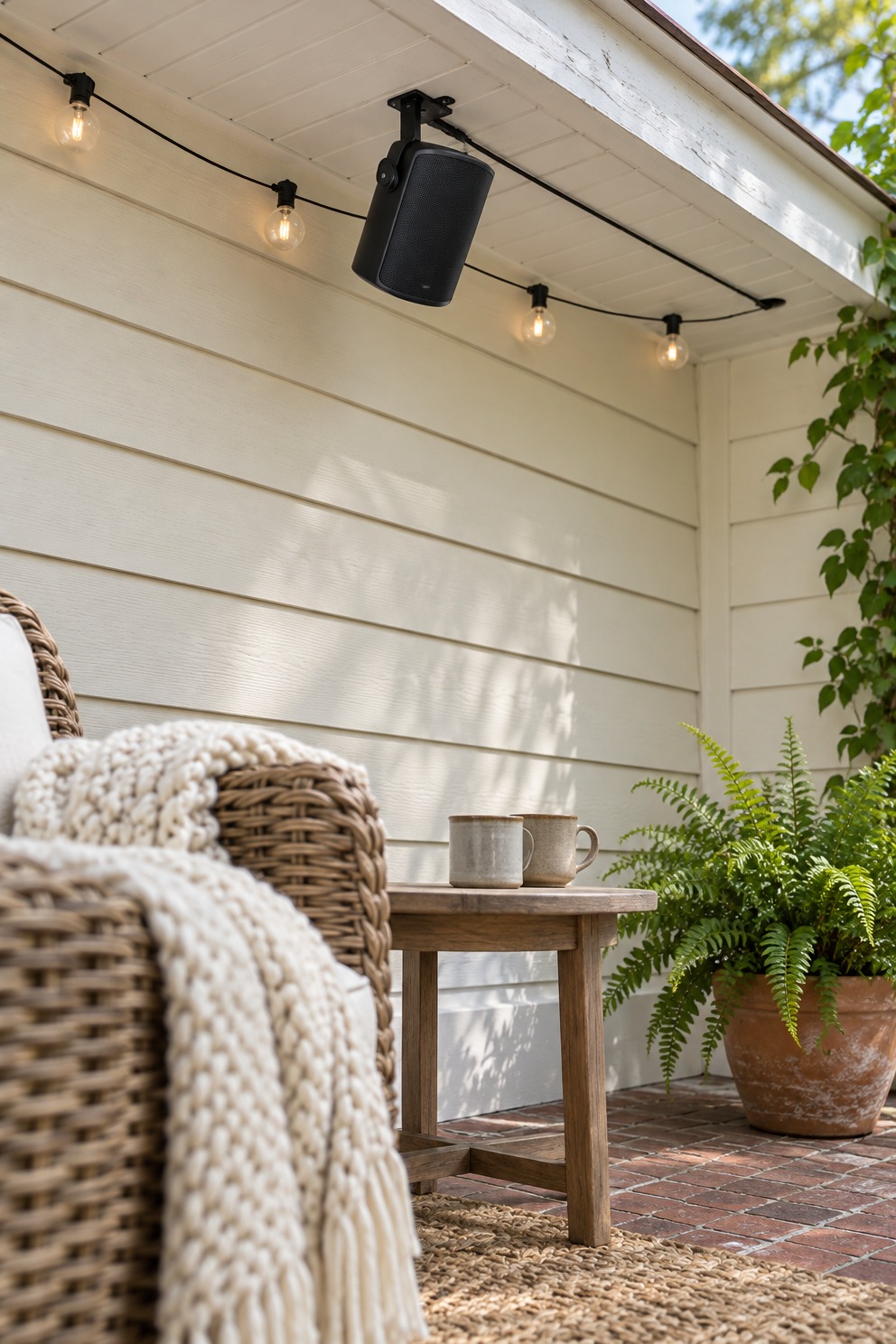
For evening outdoor listening, you want balanced sound at a low volume, not a speaker you have to turn up to hear. Two or three small speakers spread around the seating give you good sound and stereo sound from every chair, which is why a landscape system feels calmer than one loud pair on the wall. Wall speakers have a small tweeter you can see, so pick a black or white finish that matches the trim. Rock speakers disappear into a planter, and a stake speaker vanishes in a flower bed. For backyard parties, add a subwoofer. For a quiet evening with a book, the sound quality of one pair is plenty.
How to place outdoor speakers around a small patio
- Walk the route from the amplifier to each speaker spot with a string, around corners and along the wall, so you know how much wire you need.
- Mount wall speakers under the eave, angled down at the seats and away from the neighbor’s windows.
- Put the speakers where the sound reaches the farthest chair, not just the nearest one.
- Test from that farthest chair at the volume you will actually use, before you add another speaker.
Buried runs need direct-burial wire; ask the installer or check the box.
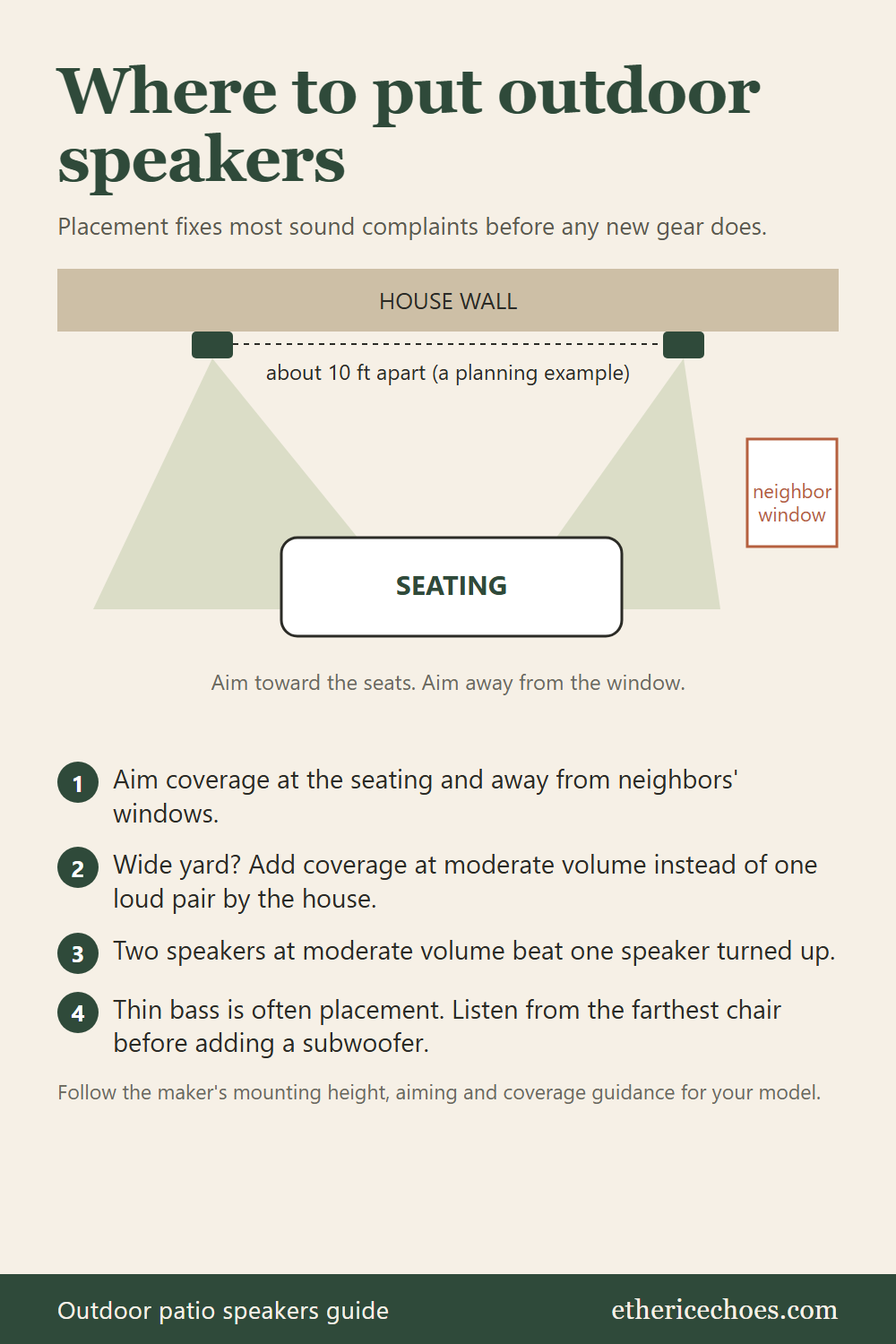
Do you need an amplifier for outdoor speakers?
Yes, if the speakers are wired. The Polk Atrium 4 and Klipsch AW-650 are both passive, so Tom’s Guide says they need something to power them, and recommends the Wiim Amp, which sits indoors with the speaker wire run through the wall. Sonos by Sonance speakers pair with a Sonos Amp. Battery Bluetooth speakers have the amplifier built in and skip all of this.
Check that your receiver lists the speakers you are buying, or ask the store before you order, and make sure it can deliver the watts above.
If you do not own a receiver with a spare zone, the amplifier is a real part of the budget. One review of seven wired outdoor speakers found that the amplifier can add hundreds of dollars on top of the speakers (Finds We Trust). Price the amplifier before you pick the speakers.
For where the chairs go, see the small-patio layouts, and plan string lights at the same time so cables and mounting points do not collide.
Adding outdoor speakers to a Sonos or Wi-Fi system
If you already own a Sonos setup, you do not need a separate stereo. Crutchfield says Sonos by Sonance outdoor speakers connect to a Sonos Amp, and the Sonos Port can add streaming to an outdoor system you already have. The speakers are still wired, so the placement advice above still applies.
Wi-Fi speakers only work within range of your router, and a battery model still comes inside at night. Crutchfield notes that the portable Sonos Move 2 and Roam 2 double as Bluetooth speakers when you are out of Wi-Fi range.
Weatherproof outdoor speakers and year-round use
Crutchfield separates two terms. Many outdoor speakers are weatherproof and handle rain, sun and cold. Others are only weather-resistant, so mount those under a roof.
Can I leave outdoor speakers out all winter?
Only if the maker says so. Of the speakers on this page, the OSD LS3 lists a temperature range of -20°F to 200°F. Polk lists the Atrium 4 as All-Weather certified, the Theater Solutions listing names snow and ice, and the Dual listing says covered areas only.
- Under a roof, a weather-resistant speaker is usually fine. On an open patio, pick a speaker the maker rates for year-round outdoor use, or bring it in for the worst of the winter.
- Bring battery speakers inside when the weather turns.
- Take a look at mounts and seals each spring.
Battery Bluetooth speakers when you cannot run wire
A wireless speaker is the right call for a rental or a patio you will rearrange. Two portable models were in stock on October 12, 2026. The OontZ Angle 3 Gen 4 (opens Amazon in a new tab)As an Amazon Associate, we earn from qualifying purchases. Full disclosure. (paid link, cost tier $) handles splashes and light rain, with a listed 24 hours of battery life at two-thirds volume. The Turtlebox Ranger (opens Amazon in a new tab)As an Amazon Associate, we earn from qualifying purchases. Full disclosure. (paid link, cost tier $$$) is rated IP67, has magnetic mounts, and syncs with other Rangers for stereo. Both come inside when you are done, and neither fills a yard the way a landscape system does.
If you want a name-brand portable for yard parties, the table near the top has the numbers: the JBL Charge 6 at 40 W and IP68, the Bose SoundLink Max at 50 W and IP67, the JBL Xtreme 4 at 30 W with 24 hours of battery, and the small JBL Go 4 at 4.2 W. A small box has to work hard in open air, so the bigger the watts and the box, the better it fills a patio. Bluetooth from a phone is fine for background music, but it is a different job from a wired system.
Is JBL or Bose better for an outdoor speaker?
Neither wins outright. What Hi-Fi names the JBL Charge 6 its best outdoor speaker overall and the Bose SoundLink Max its best premium pick, and calls the JBL Xtreme 4 the better buy at the SoundLink Max’s price.
| JBL Charge 6 | Bose SoundLink Max | |
|---|---|---|
| Power | 40 W | 50 W |
| Weather rating | IP68 | IP67 |
| Battery | 20 hours (28 with Playtime Boost) | Up to 20 hours |
| Size (height, width, depth) | 9.8 x 22.9 x 9.8 cm | 12 x 26.5 x 10.5 cm |
Pick the Charge 6 for the extra water protection and the smaller box. Pick the SoundLink Max for the extra power and the larger body.
How long does a portable outdoor speaker’s battery life last?
From 7 to 24 hours, depending on the model. The What Hi-Fi? spec boxes list the JBL Go 4 at 7 hours, the Charge 6 at 20, the SoundLink Max at up to 20 and the Xtreme 4 at 24. The OontZ above lists 24 hours at two-thirds volume. Battery figures are measured at a moderate volume, so a loud party runs shorter. Crutchfield’s advice is simply to keep a portable speaker charged.
Outdoor speaker questions
Are wired outdoor speakers better than wireless?
Wired speakers draw their power from an indoor amplifier, so they can play louder, and they have no battery to charge. You pay for that in install work. A battery speaker suits a renter or a spot you move around.
Do wireless speakers sound as good as wired ones?
Usually not at the same size. A wired pair has an amplifier behind it, gives you real stereo sound with enough volume for a party, and can be a lot bigger than a pocket Bluetooth box, which is why Tom’s Guide notes that Bluetooth speakers generally do not sound as good as wired or Wi-Fi ones. The gap shrinks with a good powered Bluetooth pair, and a wireless speaker is still the better pick if you cannot run wire.
What are the disadvantages of wired outdoor speakers?
The wire and amplifier take planning and an afternoon of work, and a buried cable is hard to move later. Crutchfield also says the effort grows with the size of the system. In return you get the best sound and a system you can expand.
How many outdoor speakers does a small patio need?
Audio Advice says one pair is usually enough for a porch walled on three sides and under about 20 ft long. An open patio has nothing to hold the sound in, so it may need more than one pair. With landscape speakers, one covers 250 to 500 sq ft by Origin’s figure, so a 12 by 14 ft patio (168 sq ft) needs two for stereo and an even level.
What is the best outdoor speaker for a small patio?
A pair of wired wall or eave speakers such as the Polk Atrium 4 for seats against the house, or one battery speaker such as the JBL Charge 6 if you cannot run wire. For seats out in the yard, landscape speakers spread the sound better than one loud pair.
What are the best brands of outdoor speakers?
Polk, Klipsch and Yamaha make wall-mount speakers that show up in the reviews we read, and OSD, Theater Solutions and Origin Acoustics make rock and landscape models. JBL and Bose make portable Bluetooth speakers. No brand wins on its name. Compare whether the speaker is battery or wired, whether it is rated for year-round outdoor use, and whether it is sold as a pair or one at a time.
Do landscape speakers need a subwoofer?
For bass, yes. Small landscape speakers like the OSD LS3 above start around 150 Hz, and one buried Origin subwoofer covers roughly 1,000 to 2,000 sq ft.
Sources for the model numbers
- What Hi-Fi?: best outdoor speakers 2026: JBL and Bose specs, the IP explanation and the best-overall, premium and large picks.
- Tom’s Guide: best outdoor speakers: Polk Atrium 4, Klipsch AW-650 and Sony ULT Field 5 specs, and the passive speaker and Wiim Amp note.
- This Old House: outdoor speakers: 40 watts per channel and the IPX5 pool minimum.
- SoundCertified: outdoor speaker basics: watts for small patios, parties and subwoofers.