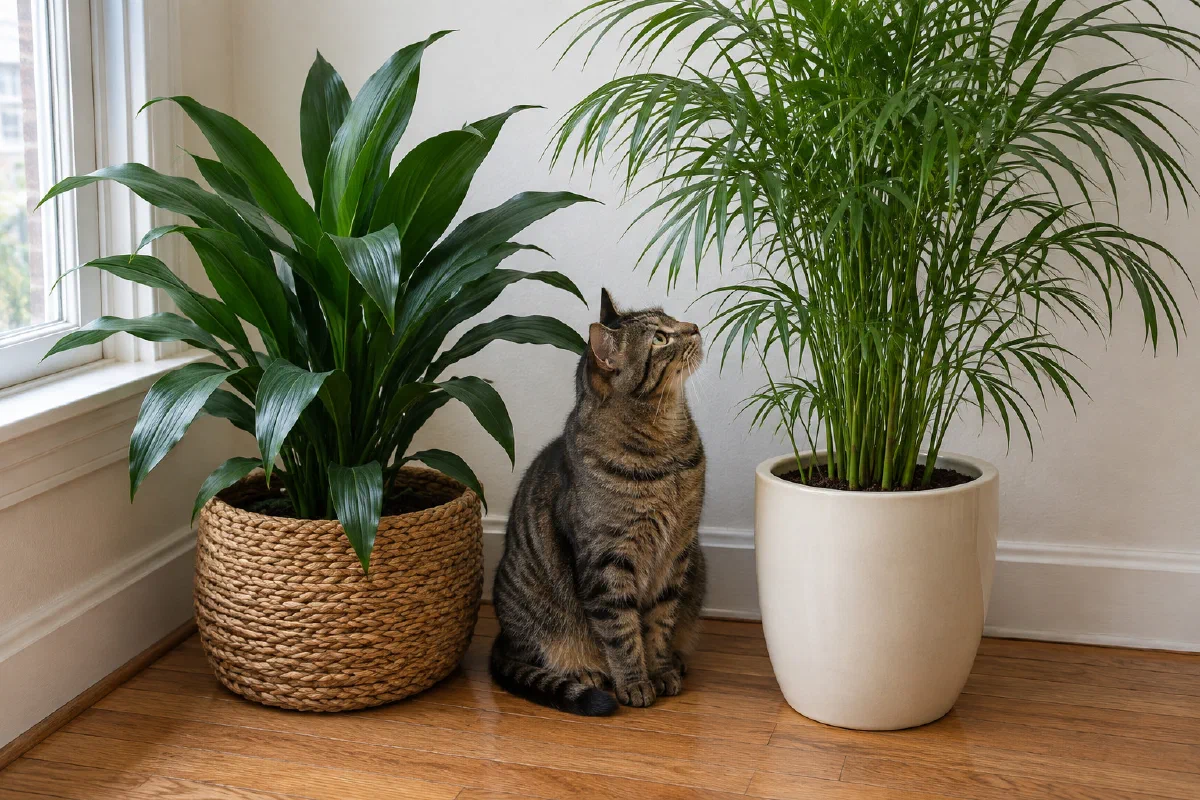
The short answer: the houseplants safe for cats and dogs verified here are cast iron plant (Aspidistra elatior), parlor palm, kentia palm, areca palm, calathea, prayer plant, African violet, spider plant, Boston fern, Christmas cactus, wax plant, polka dot plant, peperomia, echeveria and the Phalaenopsis orchid. Twenty-three plants were checked against the ASPCA toxic and non-toxic plant list, and eight popular ones have no entry under the name people use.
Absence from that list is a gap, not a clean bill of health. The ASPCA says the list is “not meant to be all-inclusive, but rather a compilation of the most frequently encountered plants,” so a missing plant is unlisted rather than cleared. Every plant below gets one of three words.
Houseplants Safe for Cats and Dogs: The Verified List
Every status here was checked by hand, and the toxic principle column repeats the exact wording on the ASPCA page. It is blank where the page lists none.
| ASPCA common name | Scientific name | Cats and dogs | Toxic principle | Light needs |
|---|---|---|---|---|
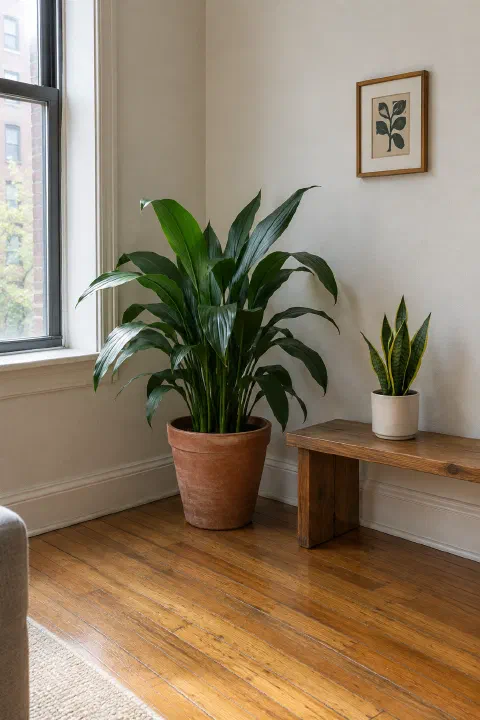
| Cast Iron Plant | Aspidistra elatior | Safe (ASPCA non-toxic) | none listed | Very low, the most tolerant here |
| Parlor Palm | Chamaedorea elegans | Safe (ASPCA non-toxic) | none listed | Low to medium |
| Kentia Palm | Howea forsteriana | Safe (ASPCA non-toxic) | non-toxic | Low to medium |
| Areca Palm | Dypsis lutescens | Safe (ASPCA non-toxic) | none listed | Medium, bright indirect |
| Calathea | Calathea spp. | Safe (ASPCA non-toxic) | none listed | Low to medium |
| Prayer Plant | Calathea insignis | Safe (ASPCA non-toxic) | non-toxic | Low to medium |
| African Violet | Saintpaulia spp. | Safe (ASPCA non-toxic) | none listed | Medium, bright indirect |
| Spider Plant | Chlorophytum comosum | Safe (ASPCA non-toxic) | none listed | Medium, holds in low light |
| Boston Fern | Nephrolepis exalta bostoniensis | Safe (ASPCA non-toxic) | none listed | Medium |
| Christmas Cactus | Schlumbergera bridgesii | Safe (ASPCA non-toxic) | none listed | Medium |
| Wax Plant | Hoya carnosa | Safe (ASPCA non-toxic) | non-toxic | Medium to bright |
| Polka Dot Plant | Hypoestes phyllostachya | Safe (ASPCA non-toxic) | Unknown | Medium |
| Golden Pothos | Epipremnum aureum | Toxic | Insoluble calcium oxalates | Low |
| Heartleaf Philodendron | Philodendron hederaceum | Toxic | Insoluble calcium oxalates | Low |
| Chinese Evergreen | Aglaonema modestum | Toxic | Insoluble calcium oxalates | Low |
| Peace Lily | Spathiphyllum | Toxic | Insoluble calcium oxalates | Low to medium |
| Snake Plant | Sansevieria trifasciata | Toxic | Saponins | Very low |
| Umbrella Tree | Brassaia actinophylla | Toxic | Terpenoids, saponins, insoluble oxalates | Medium |
| Aloe | Aloe vera | Toxic | Saponins, anthraquinones | Bright |
| Jade Plant | Crassula argentea | Toxic | Unknown | Bright |
| Kalanchoe | Kalanchoe spp. | Toxic | Bufodienolides | Bright |
| Begonia | Begonia spp. | Toxic | Soluble calcium oxalates | Medium |
| Dracaena, Red-Marginated | Dracaena marginata | Toxic | Unknown | Low to medium |
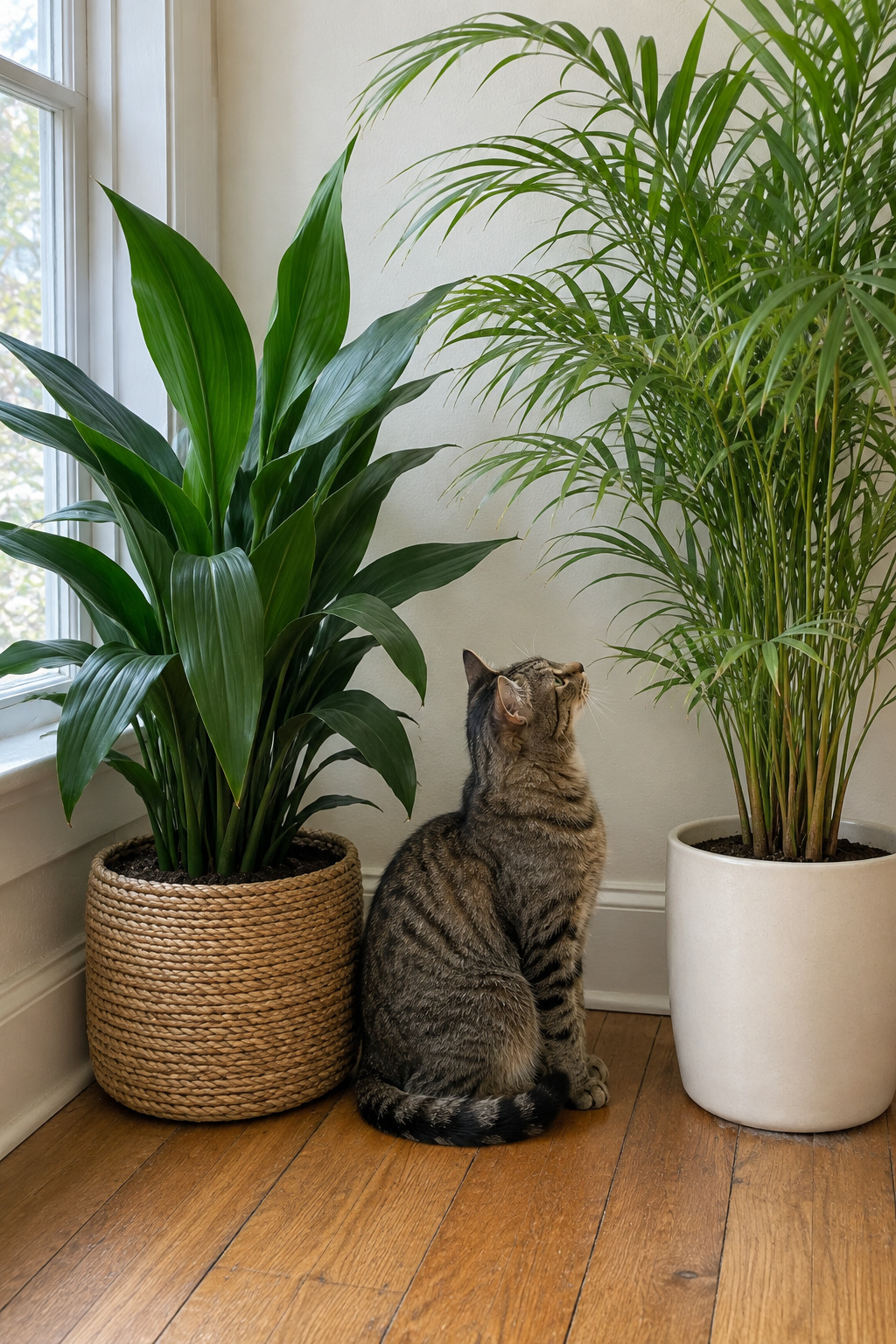
The toxic rows are the best-known low light houseplants in the country. In a dim room with a curious cat, the cast iron plant and its low light neighbors carry the least risk.
Two rows need a footnote. Polka dot plant is listed non-toxic, and the same page shows Toxic Principles: Unknown with mild vomiting and diarrhea under clinical signs, so it can still make a pet throw up. Spider plant is non-toxic, but extension services put it in the medium light group rather than the low light group.
Which Indoor Plants Are Toxic to Both Dogs and Cats
The eleven toxic plants in that table are toxic to cats and dogs. Insoluble calcium oxalates, the principle behind golden pothos, heartleaf philodendron, Chinese evergreen, peace lily, and umbrella tree, burn a pet’s mouth and cause drooling. The rest carry saponins, anthraquinones, bufodienolides, or soluble calcium oxalates, and jade plant and red-marginated dracaena list Unknown.
The Cat-Only Exception: True Lilies
True lilies (Lilium, including Easter lily) are listed as toxic to cats with no dog entry at all. The ASPCA notes cats are the only species known to be affected, and lists vomiting, inappetence, lethargy, and kidney failure, with death possible. A lily shouldn’t come into a home with a cat.
Six more entries split by species: golden pothos (also sold as Devil’s Ivy), Marble Queen, satin pothos, Warneckei dracaena, corn plant, and asparagus fern are toxic to cats and dogs but not horses.
The Common Name Trap: How to Look a Plant Up in the ASPCA Database
The ASPCA database is keyed by common name, so a search for the botanical name on the nursery tag can come back empty and look like an all-clear. That detail sits behind most wrong pet-safety answers.
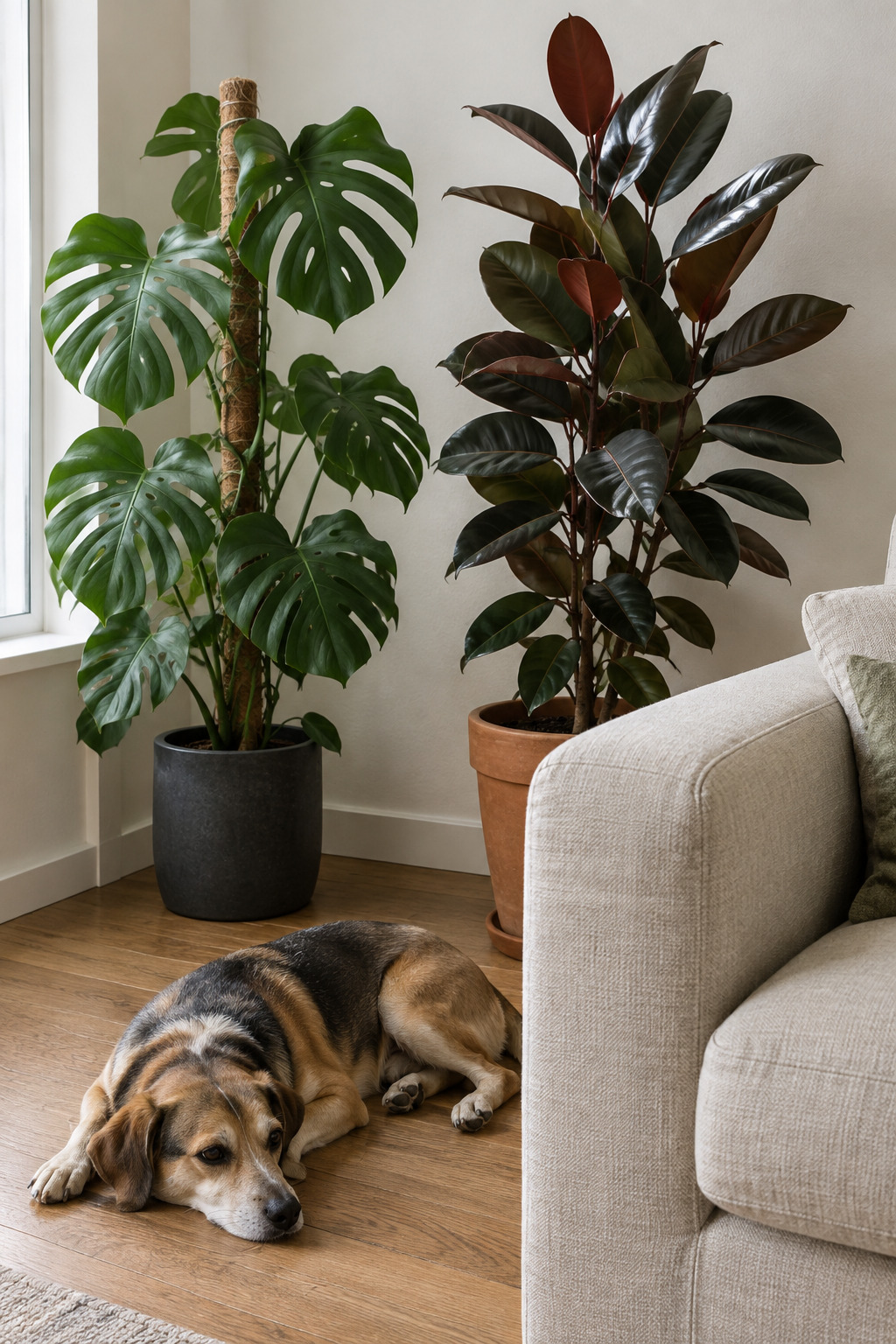
Search monstera deliciosa and there is no entry. Monstera deliciosa is in the database under Swiss Cheese Plant, and again under Cutleaf Philodendron, toxic to cats and dogs with insoluble calcium oxalates. The plant is listed. The name most people search is not.
Search rubber plant and you get nothing either. Indian Rubber Plant returns a real page, toxic to cats and dogs, with a toxic principle of proteolytic enzyme (ficin) and psoralen (ficusin), but the scientific name on it is Ficus benjamina, the weeping fig, not the thick-leaved Ficus elastica most people mean by rubber tree. Its status was borrowed from a different species that shares a common name.
Umbrella Tree is Brassaia actinophylla, toxic to cats and dogs. A separate entry called Umbrella Plant is Eriogonium umbellatum, non-toxic to all three. A common name can land you on the wrong plant.
Read the scientific name on the entry you find. If it names a different species, you verified a different plant. If nothing comes back, write Unverified and decide on placement instead of status.
Which Popular Houseplants Are Not on the ASPCA List
Every plant below returned no database entry at all: not a toxic entry, not a safe entry, nothing.
| Plant | What people assume | What the ASPCA actually has |
|---|---|---|
| ZZ plant (Zamioculcas zamiifolia) | Safe, or toxic | Unverified (absent from the ASPCA list) |
| Bird’s nest fern (Asplenium nidus) | Safe | Unverified (absent from the ASPCA list) |
| Bird of paradise (Strelitzia spp.) | Safe | Unverified (absent from the ASPCA list) |
| Monstera deliciosa | Toxic | Unverified under that name, but listed as Swiss Cheese Plant (toxic) |
| Rubber tree (Ficus elastica) | Toxic, because the rubber plant is | Unverified (absent from the ASPCA list) |
| Pilea, including Chinese money plant | Safe | Unverified (the related Friendship Plant and Aluminum Plant are listed) |
| Air plant (Tillandsia) | Safe | Unverified (absent from the ASPCA list) |
| Philodendron Birkin | Toxic, because it is a philodendron | Unverified under that name (absent from the ASPCA list) |
Three plants often listed as missing do have entries under other names: peperomia as Pepper Face (Peperomia obtusifolia), echeveria as Hens and Chickens (Echeveria elegans) and the moth orchid as Phalaenopsis Orchid. All three are non-toxic to cats and dogs.
These plants aren’t cleared. Nobody has published a verdict, so placement is your only lever.
What to Do When a Cat or Dog Chews a Plant
A chewed leaf and a vomited breakfast don’t automatically mean poison. The ASPCA says eating any plant material may cause vomiting and gastrointestinal upset, and that non-toxic plants, or mildly toxic ones, aren’t expected to be life-threatening.
- Identify the plant and the amount. Keep the tag or take a photo. “Some kind of houseplant” tells a vet nothing.
- Treat a true lily as urgent. For a cat, any part of a Lilium species is a same-day vet problem.
- Call ASPCA Poison Control at (888) 426-4435, staffed 24 hours a day. A consultation fee may apply.
- Don’t wait for symptoms. Call your veterinarian or the hotline if you believe your animal may have eaten something poisonous.
And write the plant’s name on the bottom of the pot. At ten at night, that’s the difference between a plant you can name and one you have to photograph.
How to Keep Safe Plants Out of Reach in a Small Apartment
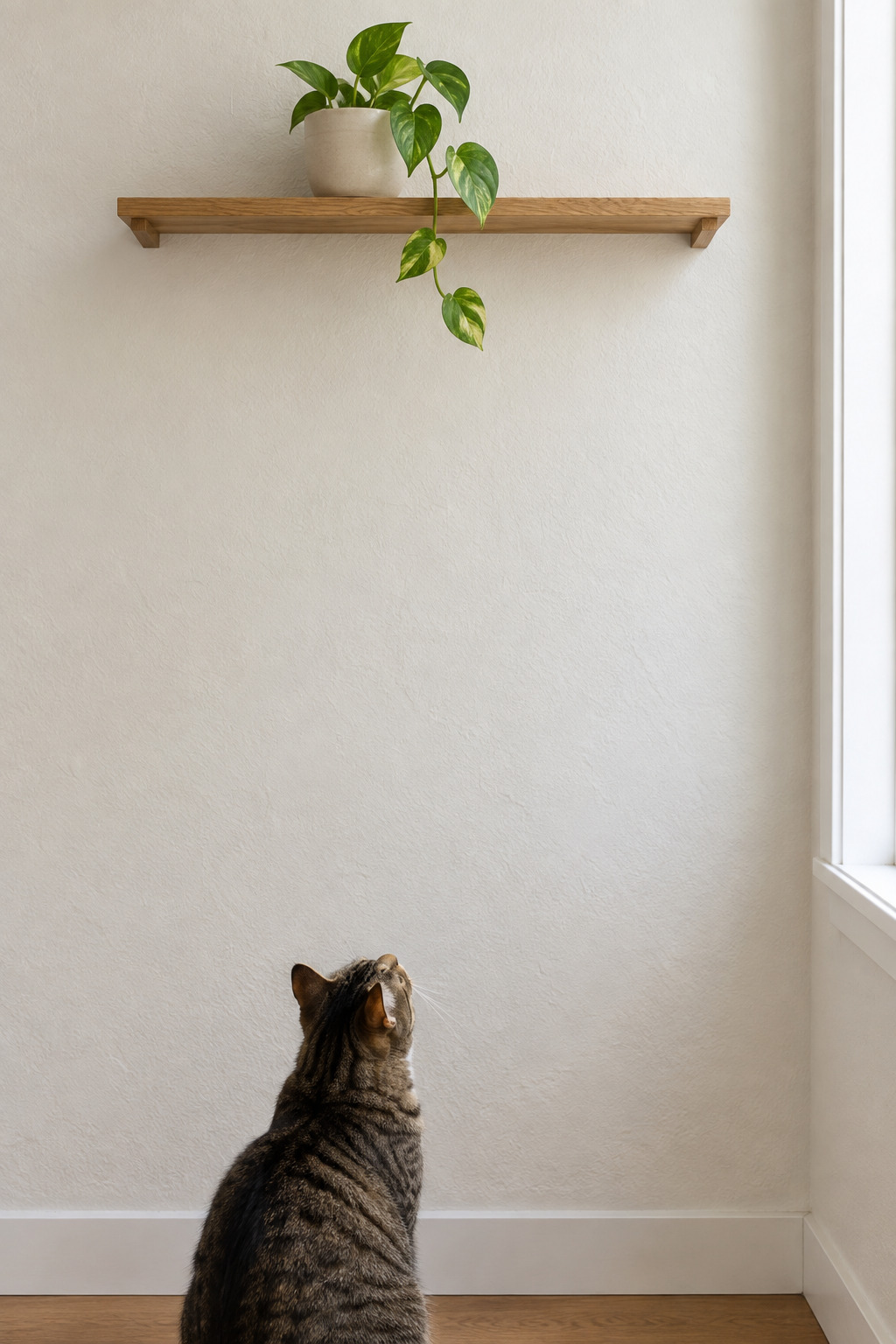
You can’t put a toxic plant out of reach in a one-room apartment by walking it to another room. A fit cat clears five to six times its own height from a standing jump, and it will use a sofa back as a step, so a plant two feet behind a chair is a plant the cat can reach.
- Safe plants go low, toxic plants go high. The height has to account for the launch pad, not just the floor.
- Use the cabinet you already have. A glass-fronted cabinet is a display case with a door, and ferns and calathea like the humidity anyway.
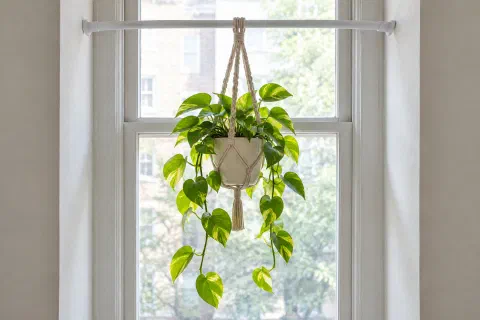
Hardware, brackets, and wet-pot weight belong to hanging a plant without drilling. For a spot with no window, plants for a windowless bathroom covers what survives there. Reading the symptoms sorts a dropped leaf from a watering problem, watering and repotting houseplants covers saucers and cachepots, and keeping a small room from turning into a jungle is the last piece.
Questions People Actually Ask
What indoor plants are safe around pets?
Verified non-toxic to both cats and dogs: cast iron plant, parlor palm, kentia palm, areca palm, calathea, prayer plant, African violet, spider plant, Boston fern, Christmas cactus, wax plant, and polka dot plant.
What plants can I have in a house with cats?
The twelve above, and no true lilies. Cats are the only species the ASPCA flags for Lilium, and the listed outcome includes kidney failure, so a lily stays out of the house.
What large indoor plants are safe for cats and dogs?
Kentia palm and areca palm both grow tall indoors and both carry a non-toxic listing. Cast iron plant stays smaller. Monstera and the rubber tree don’t qualify: monstera is toxic under other common names, and Ficus elastica has no entry.
What indoor plants are good for apartments?
For pet friendly apartment plants in a dim room, the cast iron plant is the safest bet. It’s non-toxic to cats and dogs, it takes the lowest light here, and it rarely needs repotting. The rest of the shortlist is in the table above.
Sources
- ASPCA: Toxic and non-toxic plants: every safety status here.
- ASPCA: Plant list filtered for cats: the cat-only view.
- ASPCA Poison Control: the 24-hour hotline.
- Missouri Botanical Garden Plant Finder: the botanical names used here.
- Clemson HGIC: Indoor plants, cleaning, fertilizing, containers and light requirements: light requirement groups.
- Penn State Extension: Low light houseplants: what low light means here.
- University of Missouri Extension: Lighting indoor houseplants: low light ranges in foot-candles.
- University of Minnesota Extension: Spring houseplant care: watering and drainage practice.
What to Read Next
- Low light indoor plants that survive a dark room: the same plants ranked by how little light each one tolerates.
- Plants for a windowless bathroom: what survives with no window.
- Watering and repotting houseplants: drainage holes, saucers, and cachepots.
- Houseplant problems: yellow leaves and brown tips, sorted by cause.
- Plants that make an apartment feel less sterile: what to add when a room feels like a rental.