For warm lighting in a small living room, put 2700K LED bulbs in two or three lamps at seat height, switch the ceiling light off or dim it, and keep each lamp near 800 lumens. That covers most of it. A few bulbs will do it, it works in a rental, and winter is when it pays off, because the lamps carry the room for more of the evening.
Warm Lighting for a Small Living Room: Bulbs, Lamps and Dimmers
Last updated:
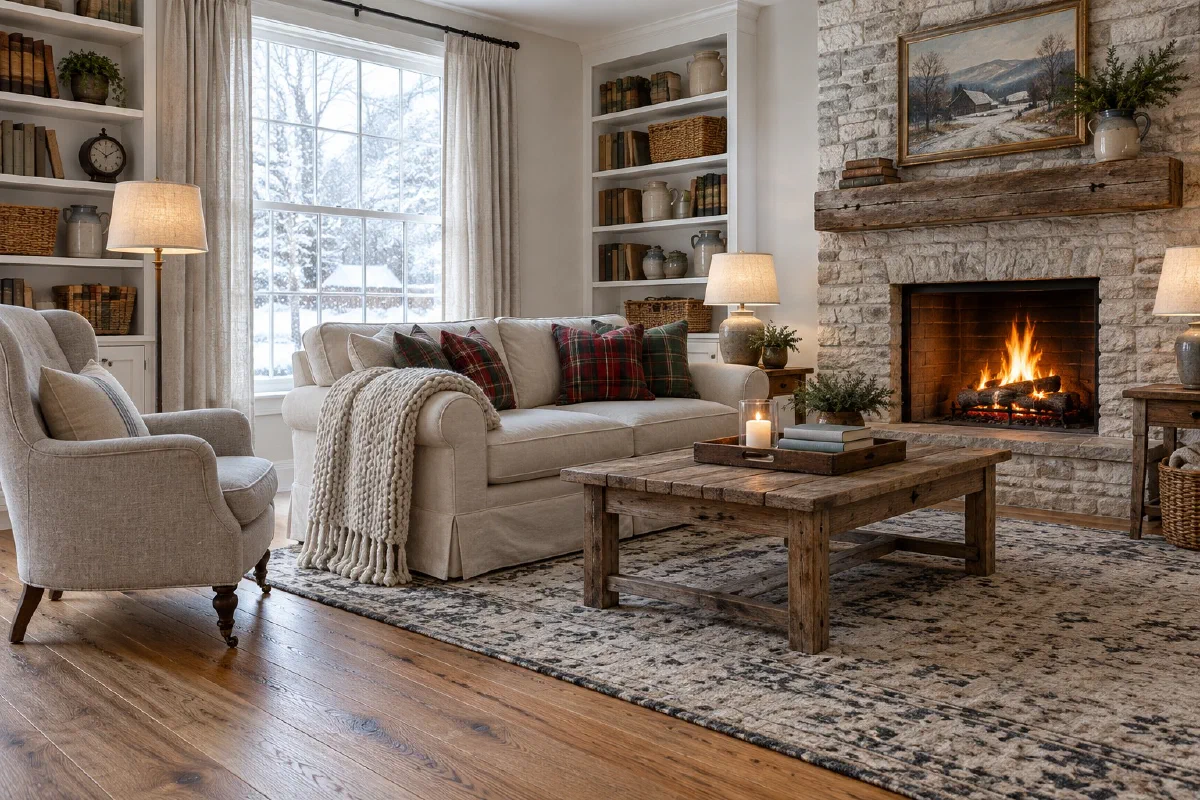
The rest of this page gives you the numbers to check on the box, where each lamp goes, and what to use if you cannot change a switch.
What Color Temperature Is Warm White? Use 2700K
Look for the Kelvin number on the box, and pick the warm end of the scale:
- 2700K to 3000K: warm, soft light, like lamplight. This is the range you want in a living room.
- 3500K to 4100K: cooler, brighter light. Offices and classrooms.
- 5000K to 6500K: blue-white light that mimics daylight.
2700K is the safest pick, and it suits wood, furniture and fabrics. 3000K is fine if your room is mostly white and grey. Go past 3500K and you are into office territory.
Words on the box are looser than numbers. Warm white, soft white and warm glow mean different things from brand to brand, so trust the Kelvin figure.
What do warm white and soft white mean on the box?
The labels are not a standard, and the guides do not agree. Most put “soft white” at 2700K to 3000K, and a box that says “warm white” could be 2700K or 3500K depending on the brand. The Kelvin number is the only safe thing to buy by.
Does warm light change how your walls and fabrics look?
Yes. The Design Confidential makes the point that one wrong bulb can make a freshly painted room look off, because color temperature changes how every surface reads. Check the throw, the sofa and the paint under your lamps after dark, not in the store or at noon.
Keep every bulb in the room on the same number. Jumping from 2700K to 4100K is noticeable and can leave the room feeling patchy.
Warm Lighting for a Living Room: The Kelvin and Lumens Chart
Pick the bulb by the job it does. Kelvin (K) is the color, lumens are the brightness.
| Spot in the room | Color | Lumens per bulb | Note |
|---|---|---|---|
| Lamp beside your main seat | 2700K | about 800 | The workhorse. Same as an old 60 watt bulb. |
| Reading chair lamp | 2700K to 3000K | 800 to 1,100 | Pick the brighter end if you sew, knit or read a lot. |
| Dark corner or shelf lamp | 2700K | 250 to 450 | A small glow, not a work light. |
| Ceiling fixture | 2700K, dimmable | 800 each, kept low | Use it as the back-up layer, on a dimmer. |
| Late-evening low glow | 2200K to 2700K | whatever you dim to | Dim-to-warm bulbs slide warmer as they dim. |
Shop by lumens, not watts: about 450 lumens is the old 40 watt bulb, 800 is the old 60 watt, and 1,100 is the old 75 watt. A 9 watt LED and an old 60 watt bulb put out about the same light.
How Bright Should Living Room Lighting Be?
For a small living room, a few lamps at about 800 lumens each, plus one smaller 250 to 450 lumen lamp in a corner, is plenty. Two 800 lumen lamps and one 400 lumen corner lamp already give you a bright, easy room before the ceiling light is on. For a glow rather than work light, start low and add brightness only where you read.
If a lamp feels harsh, drop to fewer lumens before you change the color. Put a dimmer or a fabric shade on it first.
How to Place Lamps in Layers in a Small Living Room
Urban Ambiance, Carpet One and Pooky all say the same thing: build the light in layers instead of leaning on the ceiling fixture. The layers are ambient (the general glow), task (where you read) and accent (the soft spots that make corners feel finished). Here is how that looks in a small room.
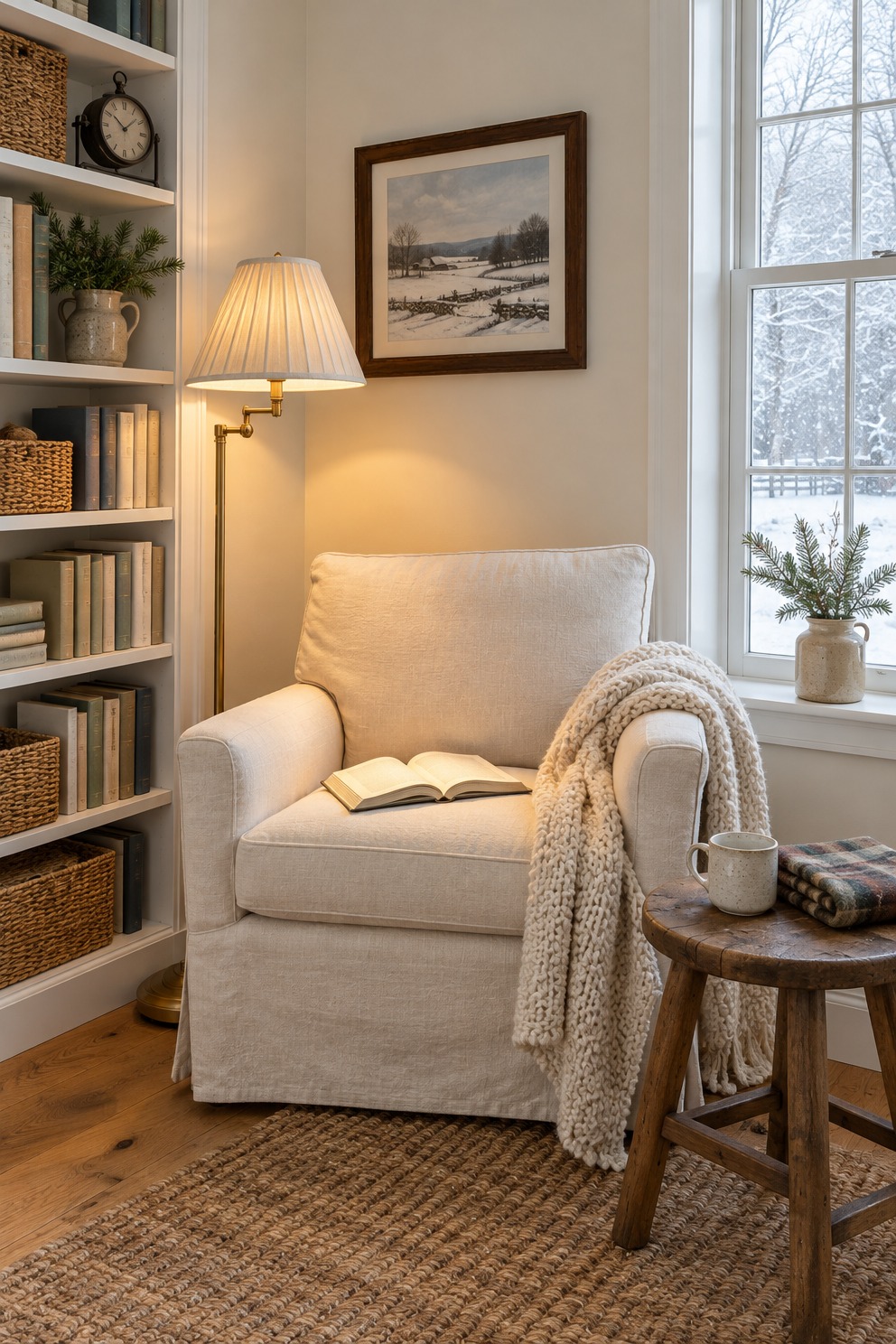
- Start with the seat you use most. Put a lamp beside it with the shade low enough that you cannot see the bulb when you sit. The light then falls over your shoulder onto the page or the phone, not into your eyes.
- Add a second lamp on the opposite diagonal. Light from two sides keeps the room from looking lopsided.
- Add a small light in the darkest corner. A 250 to 450 lumen lamp on a shelf or the floor is plenty. Dark corners are what make a small room feel shut in.
- Treat the ceiling light as the back-up. Off, or on a dimmer, at the lowest setting that still lets you find the remote. A pendant or flush mount works the same way.
- Walk the room at dusk. Switch everything on and look for any spot that still reads cold or flat. That is where the next lamp goes.
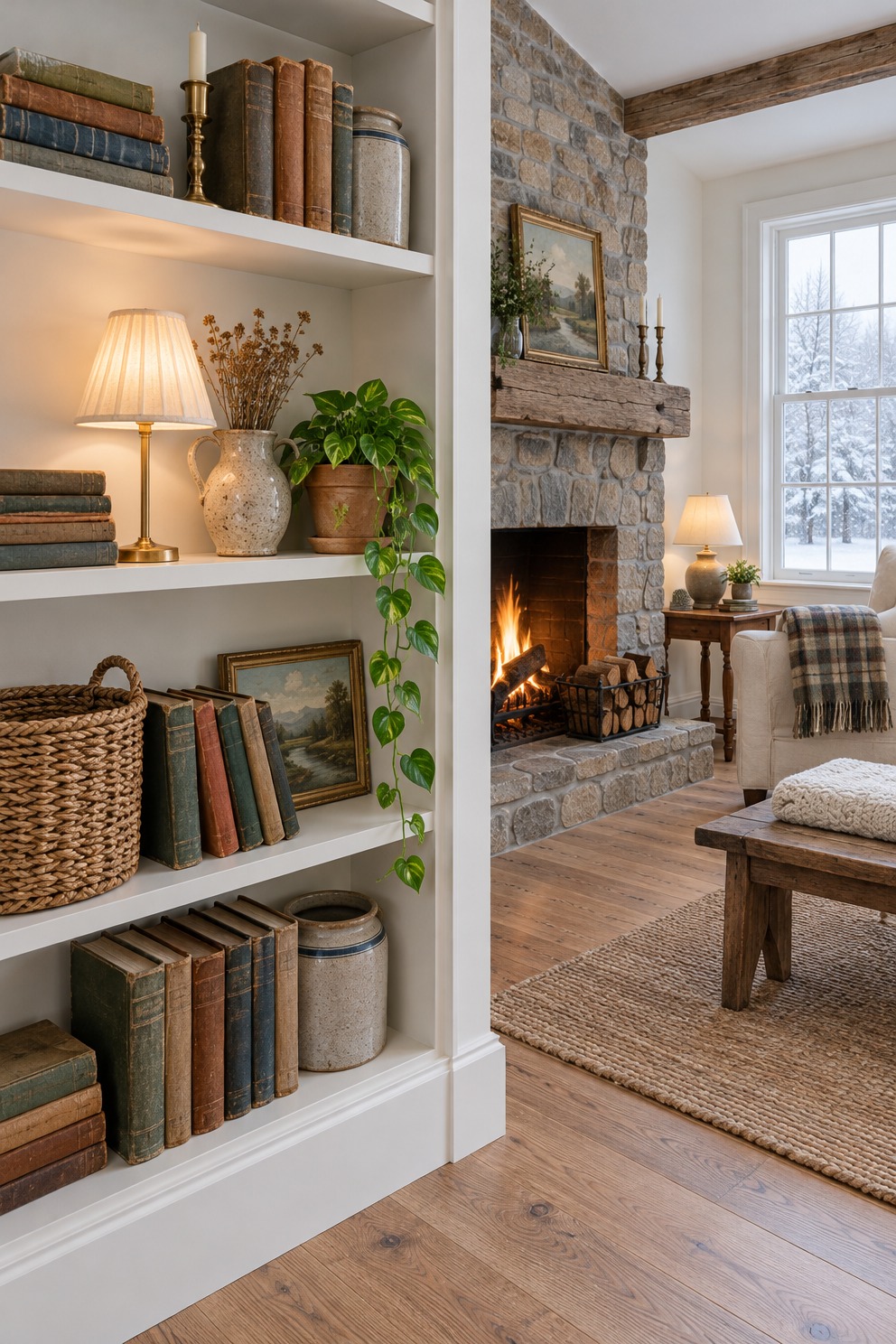
Fabric, linen and frosted shades soften the light more than clear glass. Candles on a shelf or mantel make a fine last layer when you are home to watch them. A bare clear bulb at eye level is the glare you are trying to get away from.
Can a mirror make a small living room feel brighter?
A little. Urban Ambiance suggests using mirrors to carry the light you already have across a room. Hang or lean one where it picks up a lamp’s glow from the side, such as beside the window or across from a table lamp, and not where you would see the bare bulb in it. One mirror is enough in a small room.
Do candles and string lights count as warm lighting?
They count as the accent layer. Urban Ambiance lists both as light sources for ambiance, and Pooky puts a rechargeable lamp and a flicker of candlelight among its quick fixes for a cosier room. A string of warm white lights along a shelf or around a window and a few candles on a tray give you soft glow at low cost. Neither replaces the lamps at seat height. Use flameless candles in a rental that bans flames.
Which Lamps and Fixtures Give Warm Light in a Living Room?
Every fixture type can be warm. What matters is the bulb you put in it and where it sits.
| Type of lighting | Where it helps | What to put in it |
|---|---|---|
| Floor lamp | Beside a chair or sofa end, behind your shoulder | 2700K, about 800 lumens, dimmable if you can |
| Table lamp | A side table, shelf or console | 2700K, 450 to 800 lumens |
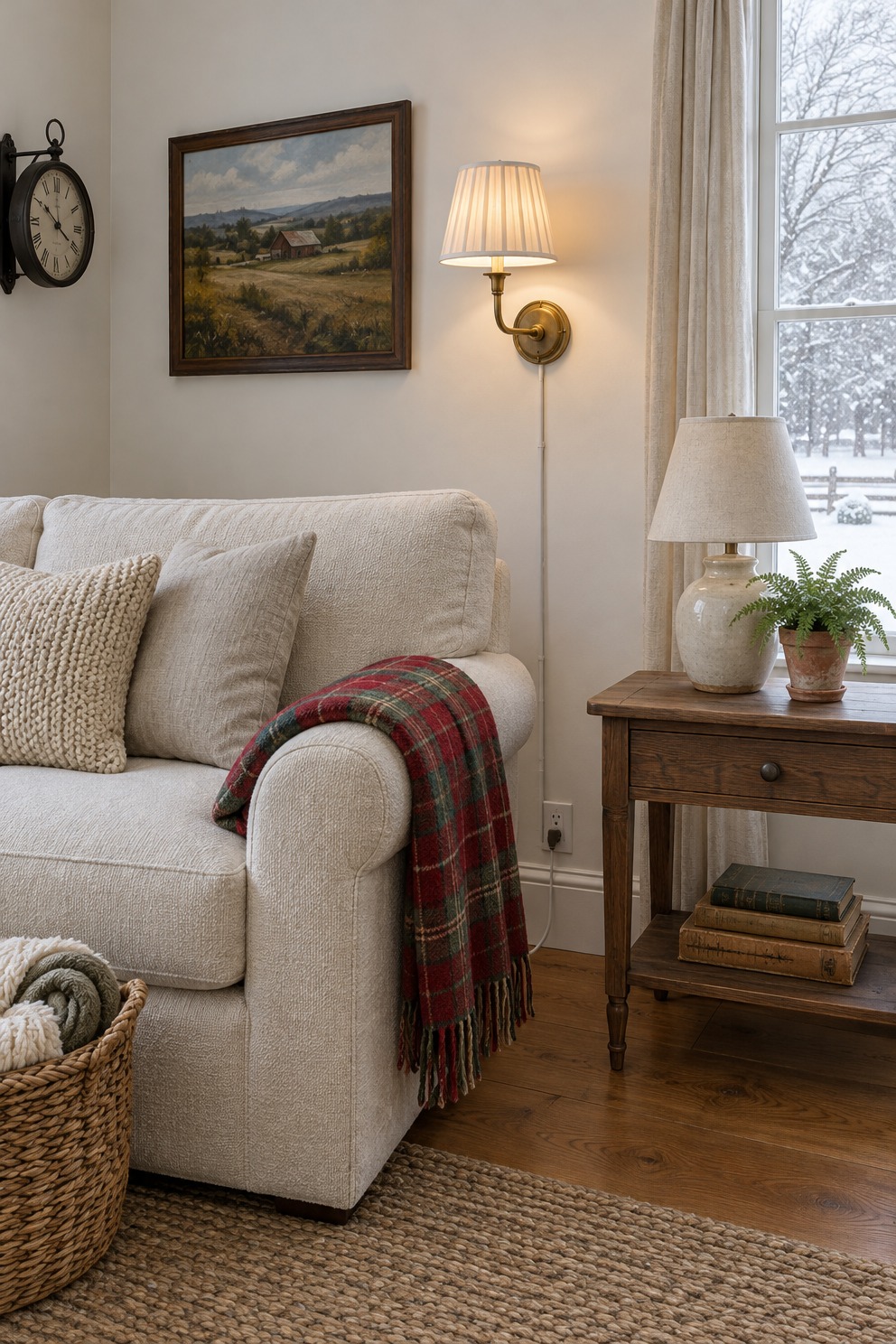
| Plug-in wall sconce | Eye-level glow without hardwiring | 2700K, low lumens |
| Pendant lights and chandelier | Back-up layer over the room or the table | 2700K dimmable, on a dimmer, kept low |
| Accent lighting | Shelf glow, picture light, string lights | 2200K to 2700K, 250 lumens or less |
A stylish fixture does not make the light warmer; the bulb does. A modern pendant with a 4000K bulb still reads cold, and an old lamp with a 2700K bulb and a linen shade reads warm.
Warm Lighting for a Living Room: Dimmers and Dim-to-Warm Bulbs
A dimmer is the cheapest way to get from reading light to movie light without changing a bulb. Three things have to match, and they are on the packaging:
- The bulb must say dimmable. Many LEDs are not, smart bulbs included, and a non-dimmable bulb will flicker or fail on a dimmer.
- The dimmer must work with that bulb. If a lamp flickers or hums at the low end, raise the dimmer’s low setting or try a different dimmable bulb.
- The fixture must allow it. A plain wall switch dims nothing, even with a dimmable bulb in the lamp.
Dim-to-warm bulbs go one step further. Instead of staying at one color, they shift warmer as you dim, the way an old filament did.
We earn a small commission if you buy through the Amazon links on this page, at no extra cost to you. The Philips Warm Glow pack linked below (opens Amazon in a new tab)As an Amazon Associate, we earn from qualifying purchases. Full disclosure. is listed as 800 lumens, dimming from 2700K down to 2200K.
Is Warm Light Better for the Evening?
For a living room, yes. Low, warm lamplight is easier to wind down in than a bright white ceiling light, so keep the lamps you leave on at night dimmed, and save cool 4000K to 5000K bulbs for the kitchen and the desk.
How to Light a Living Room With No Overhead Light, or a Switch You Cannot Change
This is the rental version. Nothing here needs an electrician, and only the sconce needs holes.
- Plug-in lamp dimmer. It sits between the outlet and the lamp cord. This Lutron kit (opens Amazon in a new tab)As an Amazon Associate, we earn from qualifying purchases. Full disclosure. pairs a plug-in dimmer with a small wireless remote that you can set on a side table, and its listing says it handles up to two table or floor lamps. Use dimmable bulbs in those lamps.
- Plug-in wall sconce. It gives you light at eye level without hardwiring. This one (opens Amazon in a new tab)As an Amazon Associate, we earn from qualifying purchases. Full disclosure. has a six foot cord and a dimmer knob on the back plate. It mounts to the wall with included hardware, which means holes, so check your lease first.
- Cordless lamp. A battery lamp goes on a bookshelf or a window ledge with no cord to hide. This small one (opens Amazon in a new tab)As an Amazon Associate, we earn from qualifying purchases. Full disclosure. lists a 2700K bulb and touch dimming, but only 250 lumens, so it is an accent, not a reading lamp.
- LED strip. Run one behind a shelf or the TV on removable adhesive. Read the listing for the adhesive type and your lease before you stick it down.
- Smart plug. If you want a lamp on a schedule, plug it in through a smart plug. Use a plain bulb in it. A smart bulb already has its own control.
- A swapped bulb. Even if you change nothing else, going from a 5000K bulb to 2700K in a fixture the landlord owns is the biggest single fix.
If you are working through the rest of a rental, our guides to small apartment living room ideas for renters and a rental that feels like home cover the non-lighting half.
Are Smart Bulbs Worth It for Warm Lighting?
They are worth it if you want one lamp to do two jobs. A tunable white smart bulb can sit at 2700K in the evening and a cooler setting while you clean or work, and you set it from your phone. This Philips Hue White Ambiance pair (opens Amazon in a new tab)As an Amazon Associate, we earn from qualifying purchases. Full disclosure. is listed as dimmable and controlled from the Hue app, with an optional Hue Bridge for voice assistants.
Two cautions. First, check that the bulb’s warm end reaches 2700K or lower, since tunable bulbs list a range. Second, do not put a smart bulb on a wall or plug-in dimmer. It dims from the app, not from a dimmer.
Pick the Right Bulb for the Fixture
Bulb shape matters as much as color. Most lamps take the standard A19 shape with an E26 base, but check the socket before you buy. Small sconces and chandeliers often use a smaller base. If a lamp has a closed glass dome, use a bulb whose box says it suits closed fixtures.
What to Buy
Same commission note as above. Cost tiers are our rough grouping: $ is a pack of bulbs, $$ is a smart bulb pair, a dimmer kit or a lamp.
- Plain 2700K bulbs for a normal switch ($): TJOY 6-pack A19, 2700K, 800 lumens, non-dimmable (opens Amazon in a new tab)As an Amazon Associate, we earn from qualifying purchases. Full disclosure.. Or Sylvania A19 2700K 800 lumens, 24 count, non-dimmable (opens Amazon in a new tab)As an Amazon Associate, we earn from qualifying purchases. Full disclosure. if you want to change the whole house at once. Do not use either on a dimmer.
- Dimmable 2700K ($): Philips LED A19 4-pack, 800 lumens, dimmable (opens Amazon in a new tab)As an Amazon Associate, we earn from qualifying purchases. Full disclosure..
- Dim-to-warm ($): Philips Warm Glow A19 8-pack, 800 lumens, 2700K to 2200K, dimmable (opens Amazon in a new tab)As an Amazon Associate, we earn from qualifying purchases. Full disclosure..
- Smart, tunable white ($$): Philips Hue White Ambiance A19 2-pack (opens Amazon in a new tab)As an Amazon Associate, we earn from qualifying purchases. Full disclosure..
- Plug-in dimmer with remote, for lamps ($$): Lutron Caseta lamp dimmer kit (opens Amazon in a new tab)As an Amazon Associate, we earn from qualifying purchases. Full disclosure..
- Plug-in wall sconce with dimmer knob ($$): VATONI dimmable plug-in sconce (opens Amazon in a new tab)As an Amazon Associate, we earn from qualifying purchases. Full disclosure..
- Cordless accent lamp, 2700K ($$): ONEWISH small rechargeable lamp (opens Amazon in a new tab)As an Amazon Associate, we earn from qualifying purchases. Full disclosure..
How to Swap a Room to Warm Lighting in One Evening
- Count every bulb you switch on after dark: lamps, sconces, the overhead, the closet.
- Note the base and shape of each. Most lamps are A19 with an E26 base.
- Buy one color temperature for all of them. 2700K, plus a spare or two.
- Change every bulb in one go, including the ones you think nobody sees.
- Decide which lamps will be on a dimmer, and buy dimmable bulbs only for those.
- Walk the room after dark with the overhead off.
Doing one lamp at a time leaves the room lit at two colors for a while. That looks worse than either one alone.
Warm Lighting Questions
Is warm white the same as soft white?
Usually close, but the words are not a standard, and sources disagree. The Spruce puts soft white at 2700K to 3000K and warm white at 3000K to 4000K. Other guides call 2700K to 3000K warm white. Read the Kelvin number on the box.
What is the best warm lighting for a living room?
Layers of 2700K lamps at seat height with the ceiling light dimmed or off. Where the lamps sit counts as much as the bulb color.
Is 3000K too cold for a living room?
It is still in the warm and soft range. It reads a little whiter than 2700K. If your room has lots of white and cool grey, 3000K can look cleaner. If it is mostly cream, wood and brown, 2700K is the more usual choice.
Can I mix warm and cool bulbs in the same room?
Mostly no. A jump from 2700K to 4100K is noticeable, and bulbs at two colors in one room make the lamps look mismatched. Integral LED, a bulb maker, takes the opposite view: warm white for the main light and cool white over work areas is fine. Both can be right. Keep everything around the sofa at one number, and use a cooler bulb only in a task lamp that lights a desk or a counter on its own. A tunable smart bulb that you set yourself is the other exception.
What are the most common lighting mistakes in a living room?
Leaning on the ceiling fixture alone, using bulbs at 3500K or cooler, mixing two Kelvin numbers in one room, and a bare clear bulb at eye level. The fixes are all above: lamps at seat height, 2700K bulbs, one number everywhere and a shade on every lamp.
Should living room lights be warm or cool?
Warm, for the evening room. Cool white at 3500K to 4100K is what offices and classrooms use. If the room is also a work-from-home spot by day, put a cooler, brighter bulb in the desk lamp only and keep the rest at 2700K.
What to Read Next
- Warm color palettes for a cozy living room if the bulb is the last step of a repaint you are already planning.
- Cozy reading nook layouts that fit a small space for the lamp placement half of warm lighting.
- Small apartment living room ideas for renters for what else you can change without touching the walls.
- Cozy apartment ideas for a rental that feels like home when you can change the bulbs but not the fixtures.