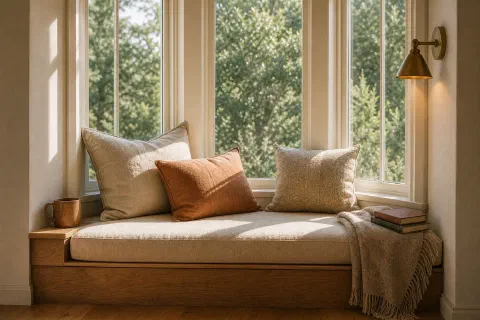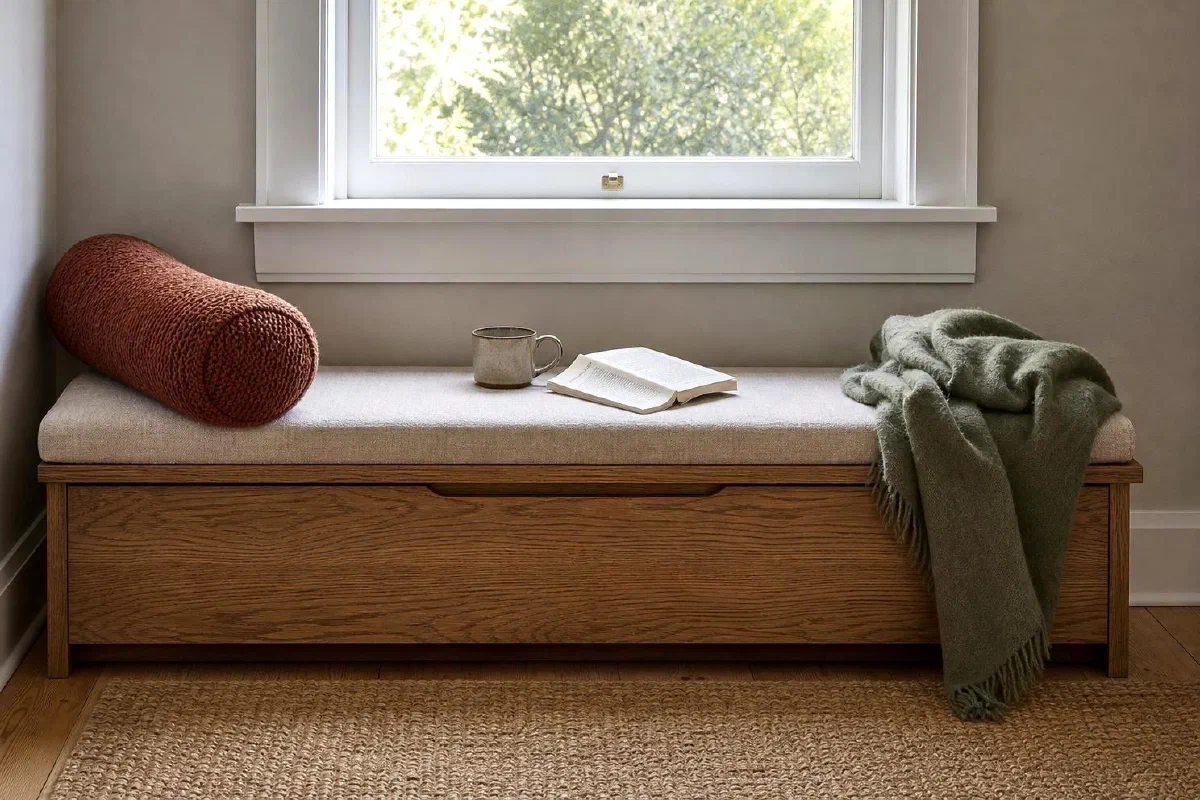
The easiest window seat for a rental is a bench or a storage chest pushed against the wall under the window, with a cushion on top that is at least three inches thick. Aim for a finished seat about 17 to 19 inches off the floor, roughly the height of a dining chair, and 20 inches deep or more if you want to sit sideways with your feet up. Nine layouts follow, from a flat window in a living room to a bay, a corner and a kitchen nook, and every one of them goes with you when the lease ends.
You do not need a deep bay or a carpenter. Most of us have one ordinary window, a small room and a landlord who would rather not find a new bench bolted to the wall. A window seat is mostly furniture, a good cushion and a lamp, and that is plenty.
Some links below are Amazon affiliate links. If you buy through them, Etheric Echoes earns a small commission at no extra cost to you.
9 Window Seat Ideas That Need No Carpenter
Each idea works under an ordinary flat window unless it says otherwise, and each can be undone in an evening.
1. A storage bench under a flat window
The shortest path to a window seat. Entry benches, blanket chests and lift-top storage ottomans are made close to seat height already, which is why they feel right the moment you sit down. Choose the longest one that fits between the window trim and whatever stands beside it, because a bench that stops short looks like it wandered in.
A lift-top bench such as this 49 inch storage ottoman bench, 17 inches tall (opens Amazon in a new tab)As an Amazon Associate, we earn from qualifying purchases. Full disclosure. ($$) gives you blanket storage inside and lands in the right height range with its own padding. A slim folding storage ottoman bench (opens Amazon in a new tab)As an Amazon Associate, we earn from qualifying purchases. Full disclosure. ($) is only 15 inches tall, so it needs a thick cushion on top to reach 18, which is what the cushion section below is for.
2. A cube shelf or low bookcase on its side
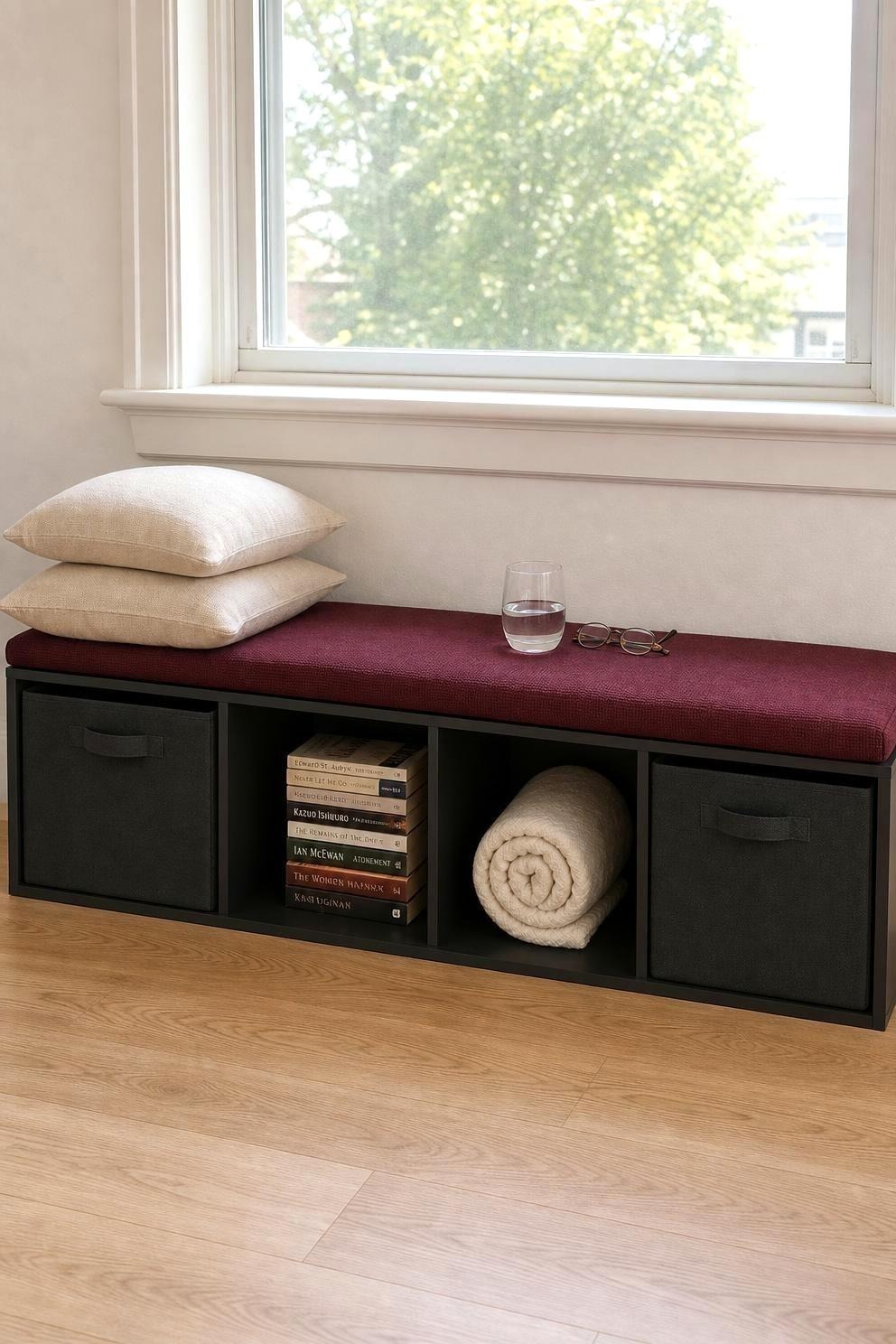
The cheapest window seat here, and often one you already own. Lay a low cube shelf or a three-shelf bookcase on its long side with the back panel to the wall. The openings face the room, fabric bins or baskets go in them, and a foam cushion lies across the top. Leave one cubby open for books so it does not read as storage furniture.
Sit on it hard before you trust it, in the middle and with no cushion. A shelf made to hold books upright is not always made to hold a person sideways. If it flexes, fill the openings with baskets, or skip the idea. If you would rather not tip a shelf over, a 3-cube storage bench with its own cushion (opens Amazon in a new tab)As an Amazon Associate, we earn from qualifying purchases. Full disclosure. ($$) is already seat height.
3. Two ottomans with one long cushion
Under a wide window, set two matching ottomans or two short, sturdy dressers side by side and lay one long cushion across both. It reads as a single built-in bench and costs a lot less than one. Push them tight together so the cushion does not dip in the gap, and use felt pads or a rug gripper underneath so nothing drifts. Two short dressers also give you drawers, which is the one thing a plain ottoman cannot.
4. A daybed or a small loveseat
In a bedroom or a home office, a narrow daybed with its long side to the wall under the window is the most comfortable version of this idea. It sits a little higher and softer than a bench, rolling bins under the frame replace a lid, and it is a guest bed on the days you need one. A small loveseat or an armless settee does the same job in a living room. If the room has to do three jobs, the layouts in our cozy reading nook guide for small spaces apply here too.
5. A deep windowsill with a cushion
Old buildings and thick walls sometimes hand you a sill deep enough to sit on. If yours is 10 inches or more, a foam slab cut to the sill makes a place to sit sideways with a mug. Be honest about what it is: under about 12 inches of depth, it is a ten-minute seat, not an hour-long one. Cut the cushion to the sill’s exact depth so nothing overhangs, and put a rug gripper underneath.
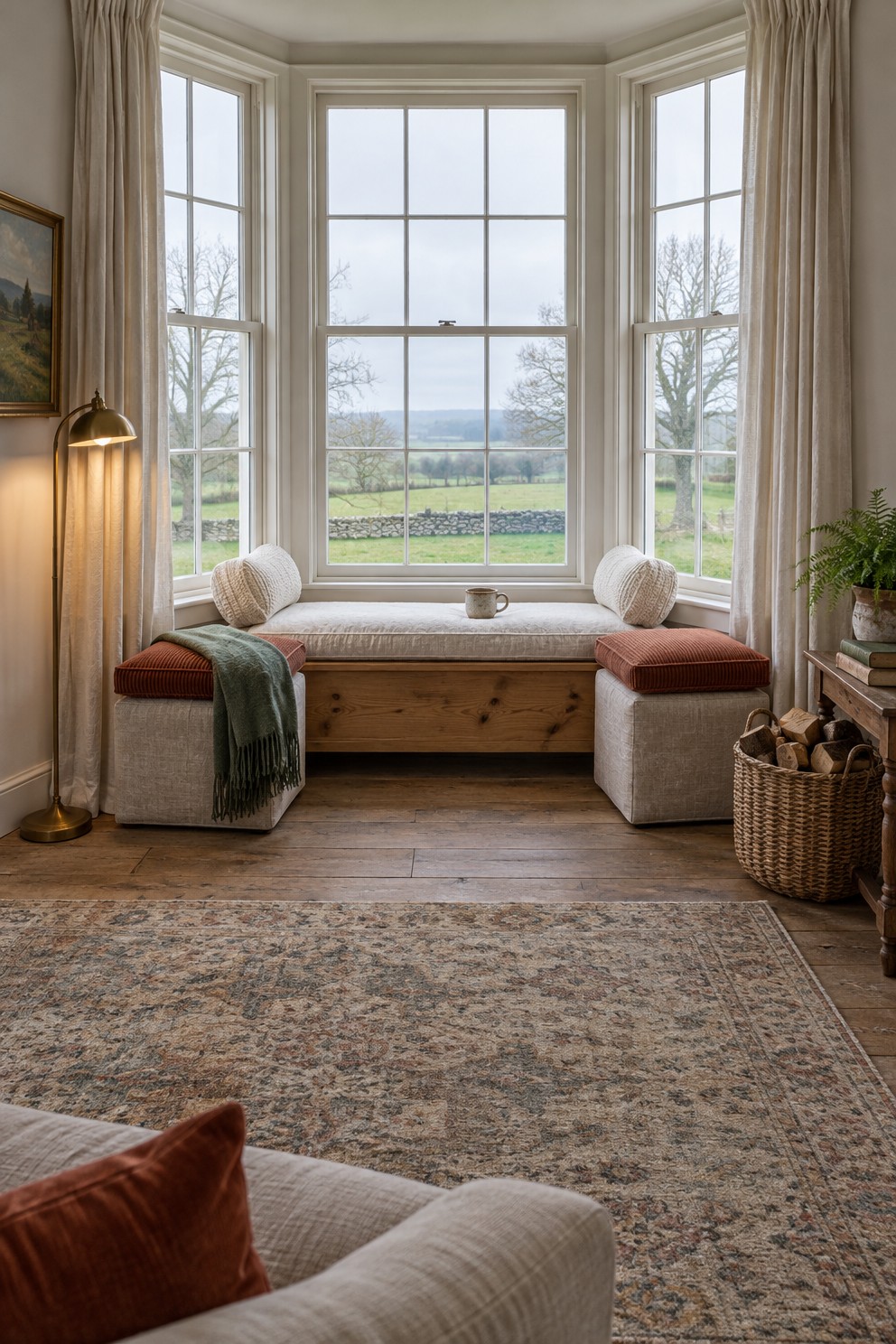
6. A bay window with a bench and two ottomans
A bay already has the alcove, so the freestanding version only has to fill it. Put a long low bench against the middle window and a square ottoman angled into each side window, then run one cushion on each. Bay seats in built-in form usually run 18 to 30 inches deep, and you can borrow that depth with loose furniture and a few big pillows. A bay is also the one spot where a mix of textiles works, a linen cushion, a wool throw and a corduroy pillow, because the windows already give the eye somewhere to rest.
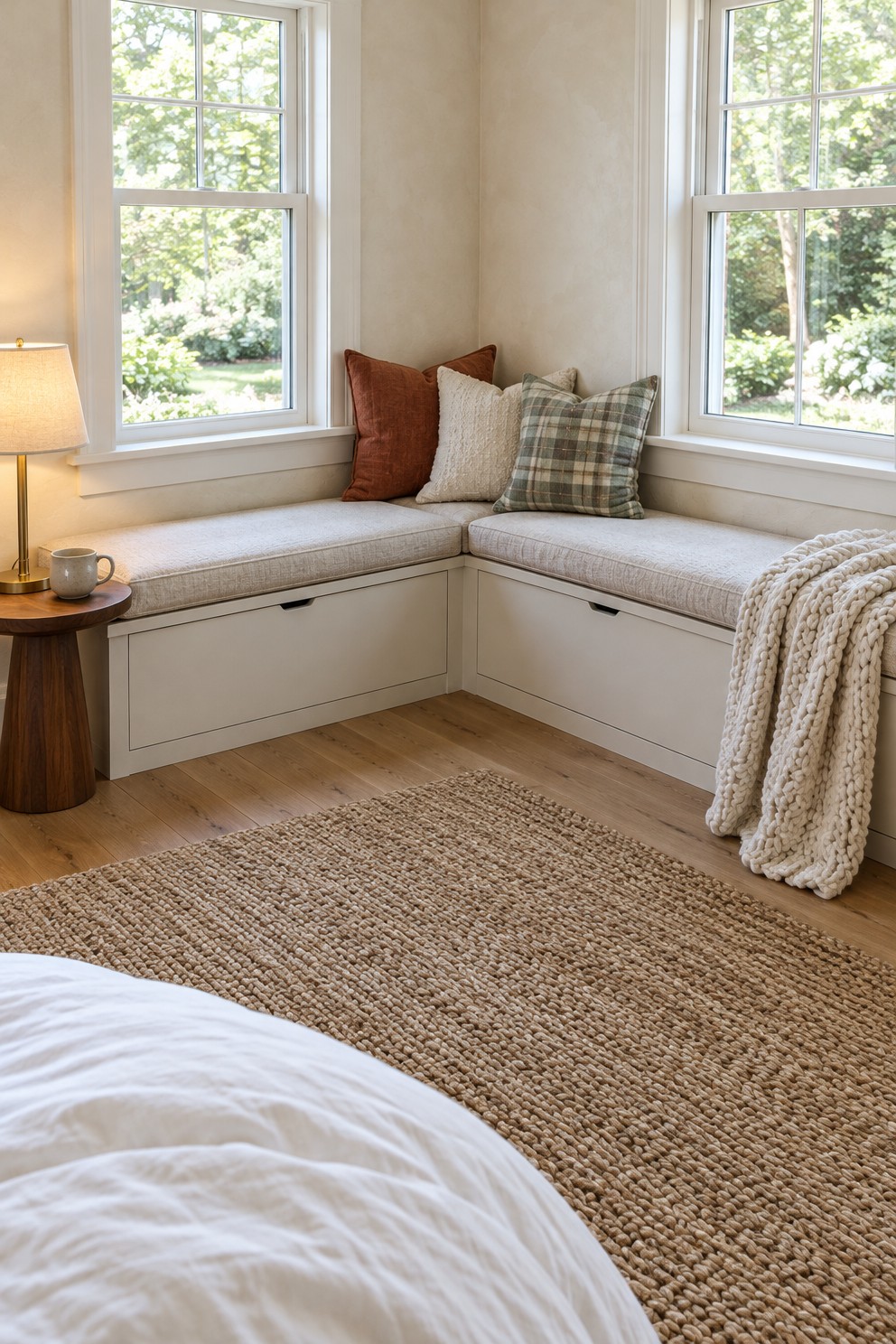
7. A corner window with two benches in an L
When a corner has a window on each wall, put a bench under each and meet them at a right angle. Top each with its own cushion, pile three pillows into the corner where they meet, and set a small round table at the end for the lamp and the mug. The L gives you a deep corner to sink into and a long side to stretch out on, and in a bedroom it takes the place of a chair you would never sit in.
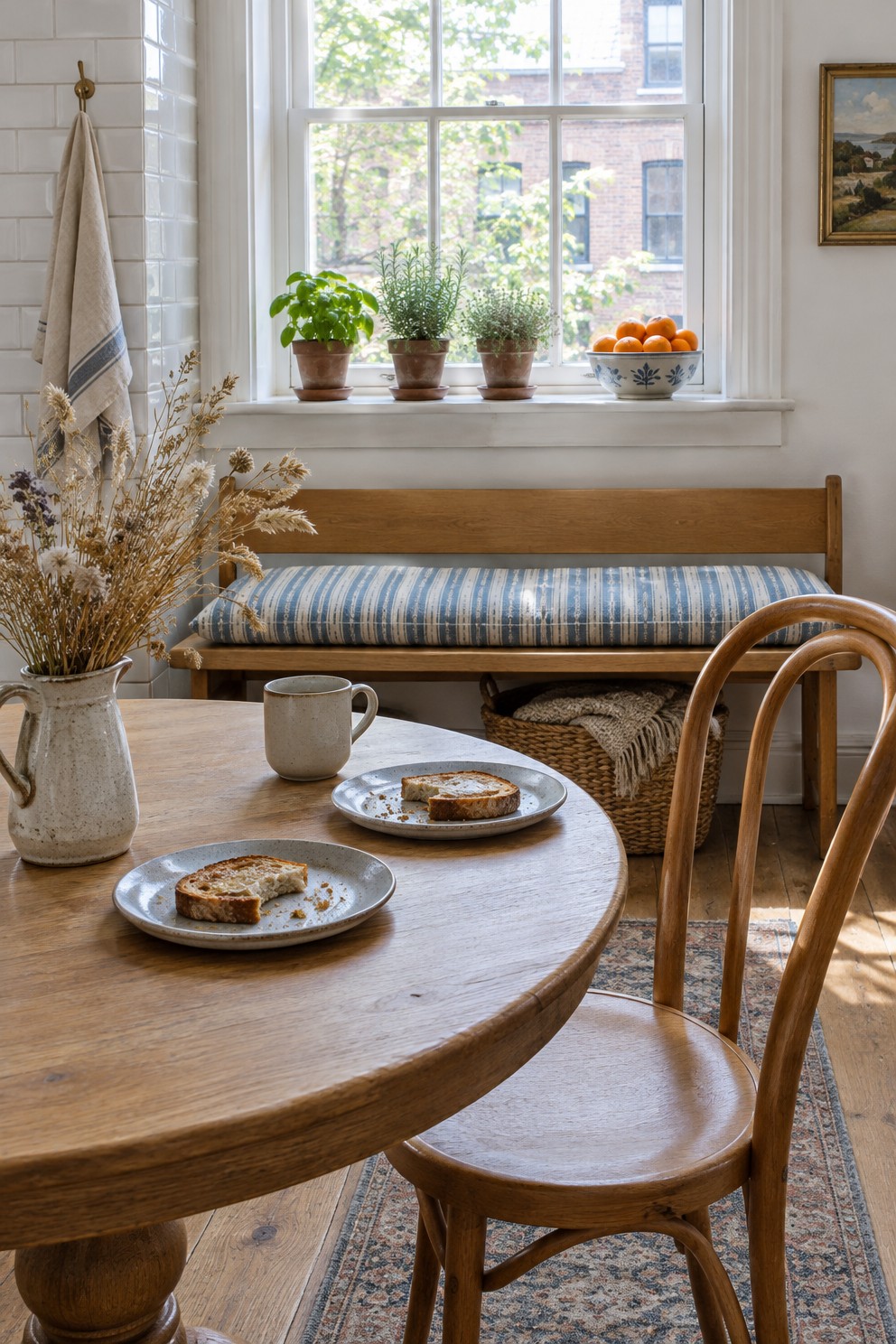
8. A kitchen or dining room nook
A slim bench under a kitchen or dining room window, with a small round table in front, turns a spare wall into a breakfast spot for two. Aim for about 16 to 18 inches deep and about 18 inches tall, so you can sit upright to eat. Match the cushion to something already in the room, a stripe like your tea towels or a plaid like the chair pads, and add a pedestal table so there are no table legs to climb over. A row of small herb pots on the sill finishes it.
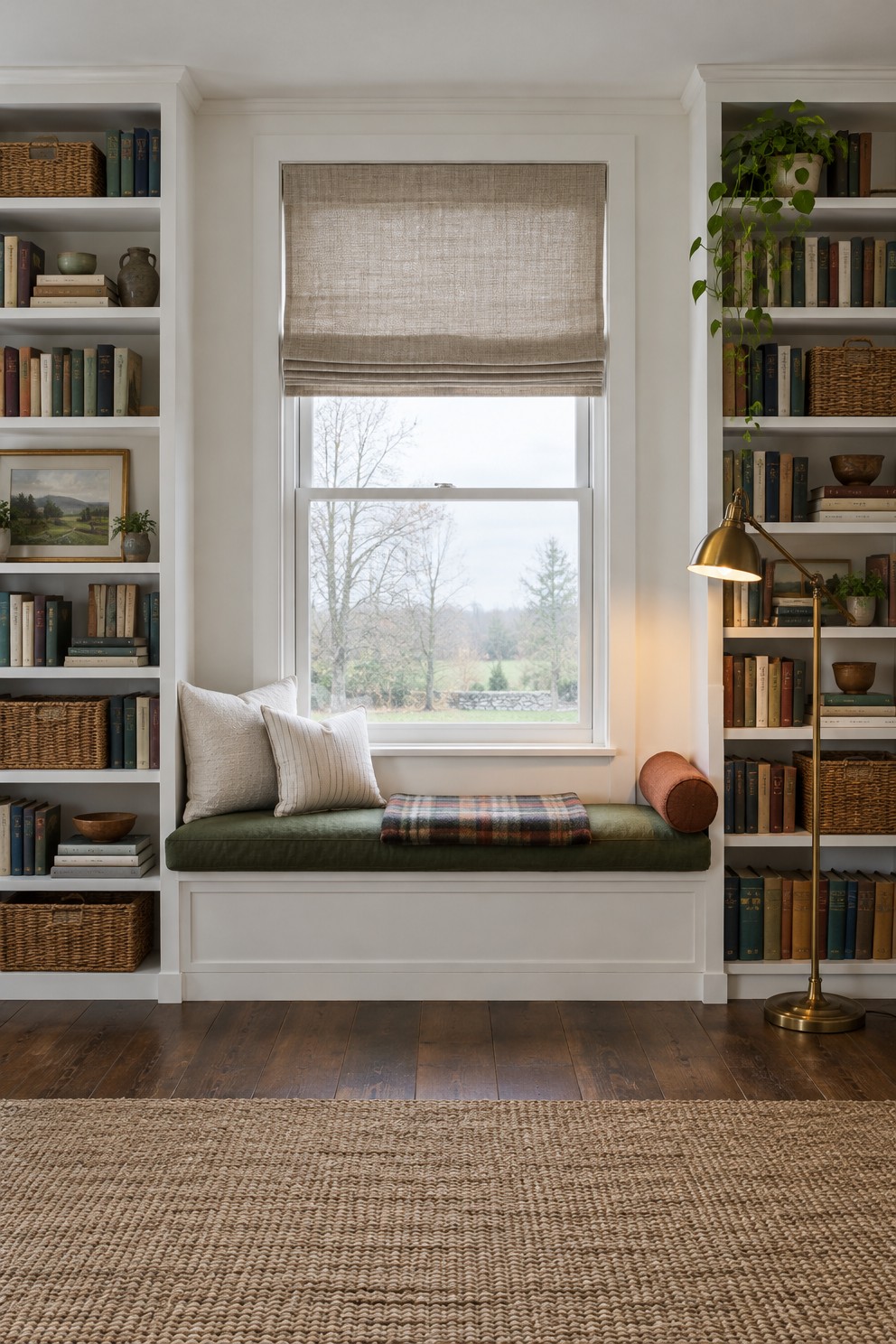
9. Tall bookcases on both sides of the window
This is how to make a plain window look built in. Stand a tall bookcase on each side of the window, put a long bench between them, and the wall suddenly looks like a planned alcove. Paint or choose the bookcases to match the wall for the full effect, and hang a roman shade inside the frame to finish the look. Strap the bookcases to the wall (two small holes, filled with spackle when you move out), then add the lamp, the throw and the books you actually read.
Window Seat Size: Height, Depth and Width
If you search for window seat size or window seating dimensions, the answers agree more than they differ. Most guides put a comfortable seat between 16 and 20 inches tall, which is chair height, and between 16 and 24 inches deep. These are the numbers to start from.
| What | Aim for | Why |
|---|---|---|
| Seat height with the cushion | 17 to 19 inches from the floor | Feet flat, easy to stand up |
| Seat depth, a perch | 16 to 18 inches | Narrow hallway or kitchen nook |
| Seat depth, a real seat | 18 to 20 inches | Knees over the front edge |
| Seat depth, for reading | 22 to 24 inches | Room to turn sideways and pull your feet up |
| Seat width | The width of the window, or a little more | Looks planned, not left over |
| Cushion thickness | 3 inches or more | Anything thinner feels like the board underneath |
| Space in front of the seat | 24 to 30 inches | So walking past does not mean squeezing |
A bay seat can run 18 to 30 inches deep, and a slim hallway, mudroom or entry seat only 14 to 16, so match the depth to the room and not to a rule.
How tall should the base be?
Work backward from the seat height you want. Seat height minus the cushion is the base you need: a 15 inch bench with a 3 inch cushion makes 18, and a 13 inch cube unit needs a 4 inch cushion for 17. If the base is too low, thicken the cushion instead of putting the bench on blocks, because a bench on blocks wobbles.
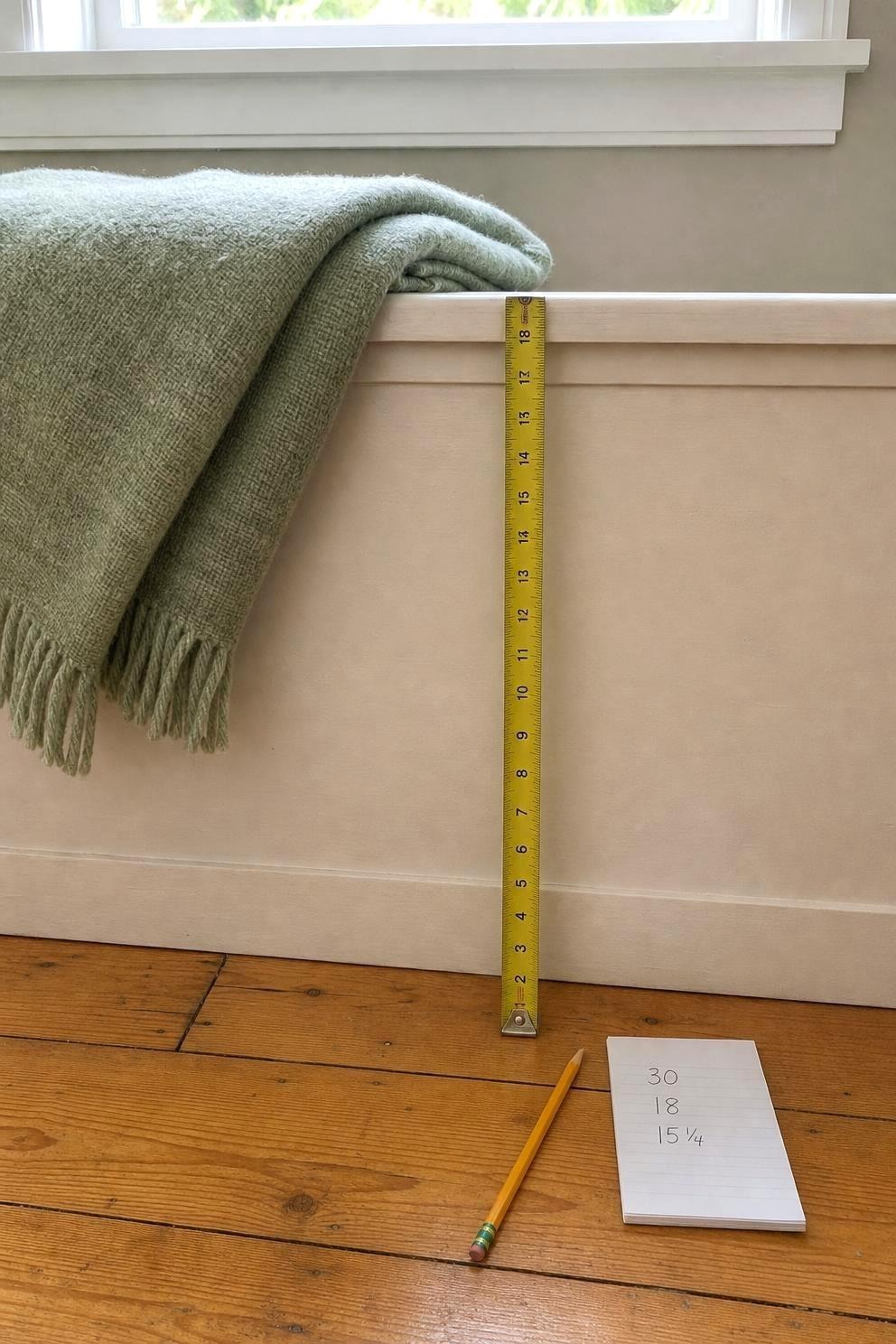
Measure the window first
Three numbers, one tape measure: the floor to the bottom of the window sill, the sill’s depth front to back, and the width of the window.
The floor-to-sill number decides the plan. A sill between 24 and 32 inches is the easy case: an 18 inch seat leaves 6 to 14 inches of wall above the cushion to lean against. Keep the top of the cushion below the sill, so the lower sash still opens and you are not leaning on glass.
How to Set Up a Window Seat in One Afternoon
- Measure the three numbers and write them on your phone before you shop.
- Clear the wall, including the radiator cover if it lifts off.
- Dry fit with no cushion. Sit on it. Check that it clears the lower sash, the curtains and any door swing.
- Do the height math. Target height minus furniture height equals the cushion thickness you need.
- Stop it sliding. Felt pads on hard floors, rug gripper on rugs. A bench that shifts an inch every time somebody sits will drift off the wall in a week.
- Put the lamp on the room side, angled over your shoulder.
- Live with it for a week before buying the pretty cushion. You will change the depth, the pillow count or the spot.
When the Window Sill Sits Too High, Too Low or Over a Radiator
Too high. Above roughly 36 inches you will not see out while seated, so stop trying. Treat it as a wall seat with good light: taller pillows against the wall, a side table at arm height and a lamp doing the reading work.
Too low. Below roughly 20 inches your back goes straight onto the glass. Pull the seat three or four inches off the wall and drop a firm bolster into the gap.
A radiator underneath. The most common blocker in an old rental. Stand a bench in front of it with a hand’s width of air behind, and call it a spring, summer and fall seat. A vented radiator cover can also work as a seat if its top is flat and sturdy, but check what the maker says it will hold.
How to Make a Window Seat Cushion Without Sewing
A hard box needs real foam on top, and you can make the cushion without a sewing machine.
- Buy foam in a slab, firm and at least 3 inches thick, for example a 3 inch by 24 inch by 72 inch firm foam slab (opens Amazon in a new tab)As an Amazon Associate, we earn from qualifying purchases. Full disclosure. ($). Cut it to the length of your bench with a long serrated knife, or have a foam shop cut it.
- Wrap it in batting. Batting rounds the sharp corners so the cushion looks upholstered instead of cut.
- Cover it so the cover comes off. A zip-around cover in cotton canvas or a linen blend is the easy route. If you do not sew, fold a length of fabric around the foam like a gift and fasten it underneath with hook-and-loop tape.
- Add bolsters at the glass. A long 8 by 36 inch bolster insert (opens Amazon in a new tab)As an Amazon Associate, we earn from qualifying purchases. Full disclosure. ($$) in a velvet or knit cover is back support in July and a draft stopper in January.
Two or three throw pillows is the whole plan. For colors that hang together with the room, our warm living room color palettes give you combinations that already work.
Window Seat Reading Nook: Light, Throw, Basket and Tray
A bench becomes a reading nook with four small things.
- Light. A lamp on the room side, angled over your shoulder, with a warm bulb. A window in front of you is a glare, so sit sideways to it and add a sheer or a light-filtering shade so midday reads as glow.
- Something soft. One wool or knit throw, folded over the arm or end of the seat.
- A basket for books. On the floor at the end, or in the open cubby under the seat.
- A tray. A small wooden tray on the cushion holds the mug, the glasses and the phone, and lifts off when you want to lie down.
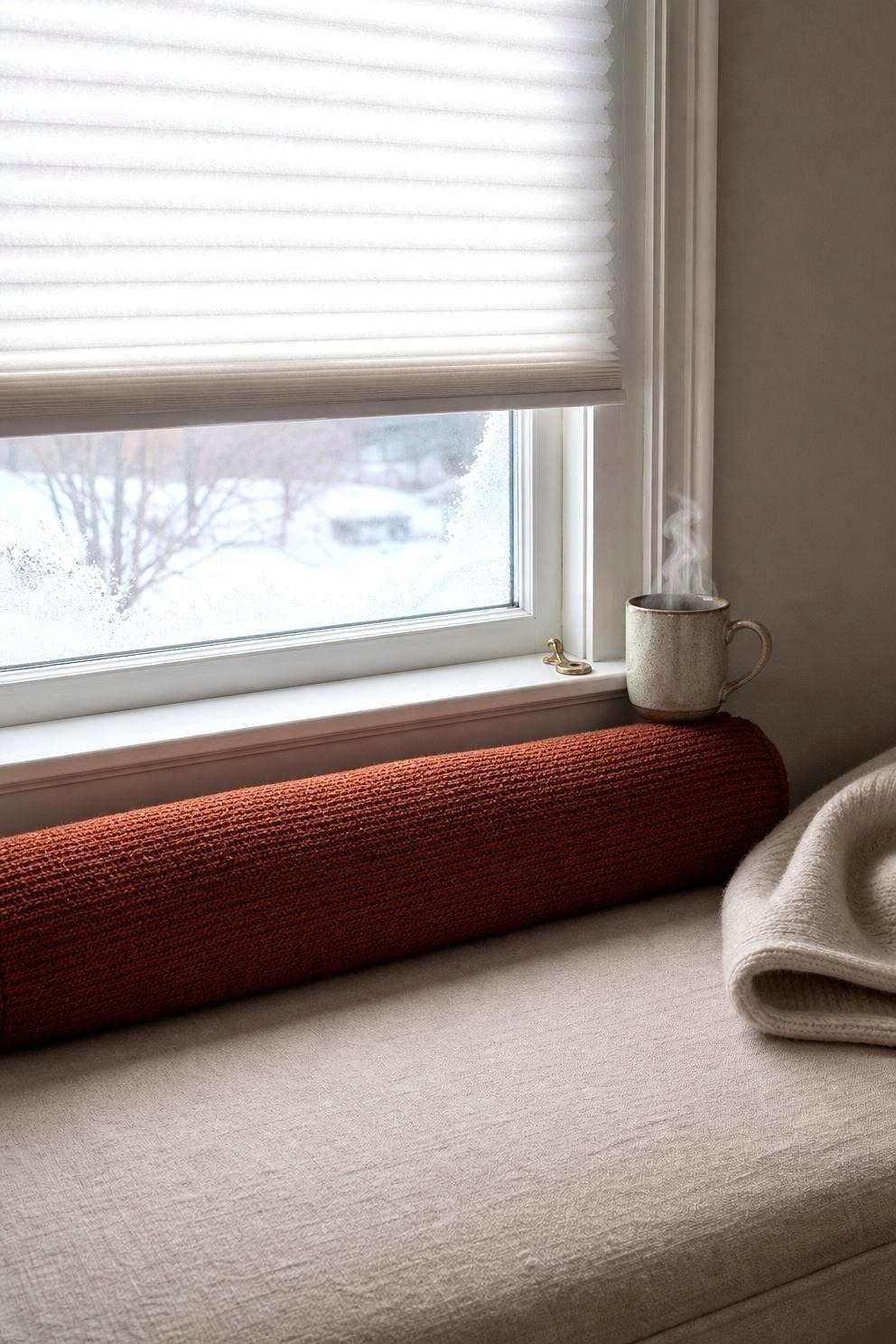
What about the cold glass?
A seat against single-pane glass in January is cold, and styling does not change that. What helps: a cellular shade lowered at night, curtains long enough to reach the sill, a bolster along the glass and a rug under the seat. Insulating window film is the renter version of a storm window and peels off in spring. Leave a finger’s width of air between the cushion and the pane so the glass does not collect damp.
Storage Under the Seat
- Open cubbies with fabric bins. For what you reach for weekly: throws, board games, magazines.
- A lidded bench. For things you touch twice a year, like out-of-season bedding.
- Rolling bins under a daybed. For bulk: shoes, wrapping paper, the suitcase.
One rule saves regret: nothing you need daily goes under a lid you have to clear first. Blankets are the exception, since a window seat is where they get used, and our blanket storage guide covers folds that survive a season in a box.
Questions People Ask About Window Seats
What is a seat under a window called?
A window seat, or a window bench. A seat built into a bay is a bay window seat, and the shallow one at sill height is often called a windowsill seat. Along a kitchen or dining room wall, the same idea is a banquette.
What is a windowsill seat?
A bench or shelf pushed flat against the wall under a window, so you sit at sill height rather than table height. Nothing about it has to be built in. A storage bench or a cube shelf on its side gives you the same thing for the price of a piece of furniture.
Are window seats a good idea?
For most small rooms, yes. A window seat turns a dead wall into seating and storage, puts you where the light is, and costs very little in the no-build version. The downsides are real, though: the wall is committed to the seat, the sill has to land near the right height, the cushion sits in the sun and fades, and hinged lids need room to swing. If the windows are cold or a toddler lives with you, think twice about a seat right under one.
How do you decorate a window seat?
Treat it like a small sofa, with good upholstery and a simple design. One long cushion, two or three pillows in a few related colors, one throw and a lamp. Hang curtains a little wider than the window to frame it, and match the pillow fabric to something in the room. A slim floor lamp beside the seat does more than a row of extra pillows.
What are some modern window seat ideas?
Modern mostly means low and quiet: one long cushion instead of a row of pads, two or three colors total, and a base you can see the floor under, such as a bench with legs or a plain pale wood box. Cordless shades inside the window frame finish it.
How can I make a DIY window seat without building anything?
Set two cube storage units end to end under the window with the cubbies facing the room, lay one board cut to the combined length across the top, and rest a foam slab in a washable cover on that. Two bolsters go against the wall. To make it look built in, paint the board the same color as the trim. Nothing is fastened to anything, which is the point in a rental, and more moves that leave no trace are in our renter-friendly cozy apartment guide.
How much does a window seat cost?
There is no single number, because it depends on the window. A built-in is carpentry: a frame, a lid or doors, a cushion cut to a size nobody stocks and someone to fit it to a wall that is probably not square. The no-build route is materials only, and you can carry it all home in one trip: a bench or two cube units, a board if you want one, and a foam slab in a washable cover. That gap is why the no-build version is worth trying first, even if you plan to build later. It tells you whether anyone in the house actually sits there.
What to Buy
Every item below is linked in the sections above. Cost tiers run from $ (least) to $$$ (most). Check the size on the listing before you order.
- Bench with storage, 17 inches tall: 49 inch lift-top storage ottoman bench (opens Amazon in a new tab)As an Amazon Associate, we earn from qualifying purchases. Full disclosure. ($$)
- Budget bench, needs a thick cushion: 43 inch folding storage ottoman bench (opens Amazon in a new tab)As an Amazon Associate, we earn from qualifying purchases. Full disclosure. ($)
- Cube bench with cushion: 3-cube storage bench (opens Amazon in a new tab)As an Amazon Associate, we earn from qualifying purchases. Full disclosure. ($$)
- Seat cushion foam: 3 by 24 by 72 inch firm foam slab (opens Amazon in a new tab)As an Amazon Associate, we earn from qualifying purchases. Full disclosure. ($)
- Back support: 8 by 36 inch bolster insert (opens Amazon in a new tab)As an Amazon Associate, we earn from qualifying purchases. Full disclosure. ($$)
What to Read Next
- Cozy Reading Nook in a Small Space has seven layouts with real footprints, for when the window is not the right wall.
- Cozy Apartment Ideas for a Rental covers the rest of the room using the same nothing-permanent rule.
- Warm Living Room Color Palettes gives you cushion and throw combinations that already hang together.
- Quiet Reading Corner Pieces lists the lamp, table and seating shapes that make a corner readable.
- Studio apartment layout ideas show seven ways to separate the bed.